
NEET Effort vs. Reward Calculator
Calculate Your Study Effort
Based on NEET preparation data, determine how much time you'll need to reach your target scores in each subject. Biology gives the highest return on effort.
Every NEET aspirant asks this question: Which subject is most easy in NEET? The truth? No subject is truly "easy" if you don’t prepare properly. But some subjects give you more return on effort than others. If you’re looking to build confidence early, score faster, or recover from a weak start, knowing where to focus can change everything.
Biology: The High-Yield Subject
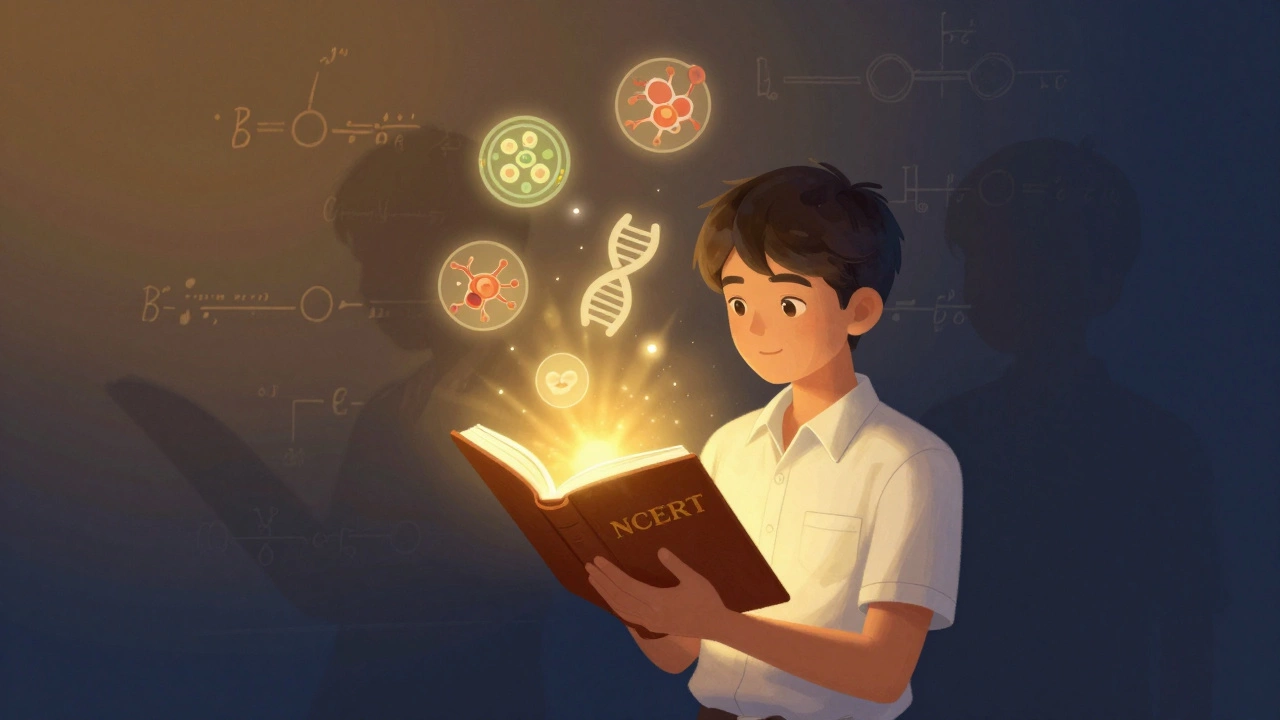
Biology is the subject most students call "easy"-and for good reason. It’s not because the questions are simple. It’s because the syllabus is predictable. Over 90% of NEET biology questions come straight from NCERT textbooks. That’s not a guess. That’s what CBSE and NTA have done for the last five years.
Take the 2024 NEET paper. Out of 90 biology questions, 78 were directly based on NCERT diagrams, tables, or exact lines of text. You don’t need to solve complex problems. You need to read, remember, and recognize. A student who reads NCERT Biology Class 11 and 12 twice can easily score 320+ out of 360 in biology alone.
Compare that to physics. Physics asks you to apply formulas in new situations. Biology asks you to recall facts. One requires thinking. The other requires repetition. That’s why toppers often say: "Biology is my safety net."
Chemistry: The Middle Ground
Chemistry sits between biology and physics. It’s not as memory-heavy as biology, but it’s not as logic-driven as physics. Organic chemistry is the key here. If you understand reaction mechanisms-like nucleophilic substitution or electrophilic addition-you can solve 20+ questions without memorizing every equation.
Inorganic chemistry? It’s mostly memorization. Periodic trends, exceptions in transition metals, coordination compounds-these are fact-based. But they’re also high-scoring. One student from Delhi scored 140/180 in chemistry just by mastering NCERT’s inorganic chapters and practicing previous year questions.
Physical chemistry is the trickiest part. It involves formulas, units, and calculations. But if you focus on just 10 core topics-mole concept, chemical equilibrium, thermodynamics, electrochemistry-you can cover 60% of the section. You don’t need to master every derivation. You need to know how to plug numbers into the right formula.
Physics: The Tough One
Physics is where most students lose marks-not because it’s hard, but because they treat it like biology. You can’t memorize your way out of a kinematics problem. You need to visualize motion, draw free-body diagrams, and understand how forces interact.
Look at the 2023 NEET paper. Physics had 45 questions. Only 8 were direct formula applications. The rest required combining concepts: like using conservation of momentum in a collision problem, then applying energy equations to find velocity. That’s not luck. That’s skill.
Students who score well in physics don’t solve 500 problems. They solve 50 problems-deeply. They ask: "Why does this formula work?" "What happens if I change this variable?" They build intuition. And that takes time.
If you’re weak in math, physics will feel impossible. If you’re good at logic and patterns, it becomes your strength. But for most, it’s the subject that drags their score down.
Why "Easy" Is Misleading
Calling biology "easy" doesn’t mean you can skip it. It means you can master it faster than physics. A student who spends 3 hours on biology daily will outscore someone who spends 5 hours on physics but doesn’t retain anything.
Here’s the real breakdown of effort vs. reward:
- Biology: 1 hour of focused NCERT reading = 2-3 correct answers
- Chemistry: 1 hour of mechanism practice = 1-2 correct answers
- Physics: 1 hour of problem-solving = 0.5-1 correct answer (if you’re still learning)
That’s why smart aspirants start with biology. They lock in 300+ marks before they even touch advanced physics. Then they use the remaining time to improve chemistry and slowly chip away at physics.
What the Top Scorers Do
NEET toppers don’t say "biology is easy." They say, "I made biology my strength."
Here’s what they actually do:
- Read NCERT biology line by line, twice before January of Class 12.
- Make flashcards for diagrams-plant anatomy, human heart, nephron, embryo development.
- Solve past 10 years’ biology papers. They notice patterns: 5 questions on photosynthesis every year. 3 on genetic disorders.
- Don’t touch physics until they’ve scored 300+ in biology mocks.
- Use chemistry as a bridge-practice reactions daily, but only after biology is solid.
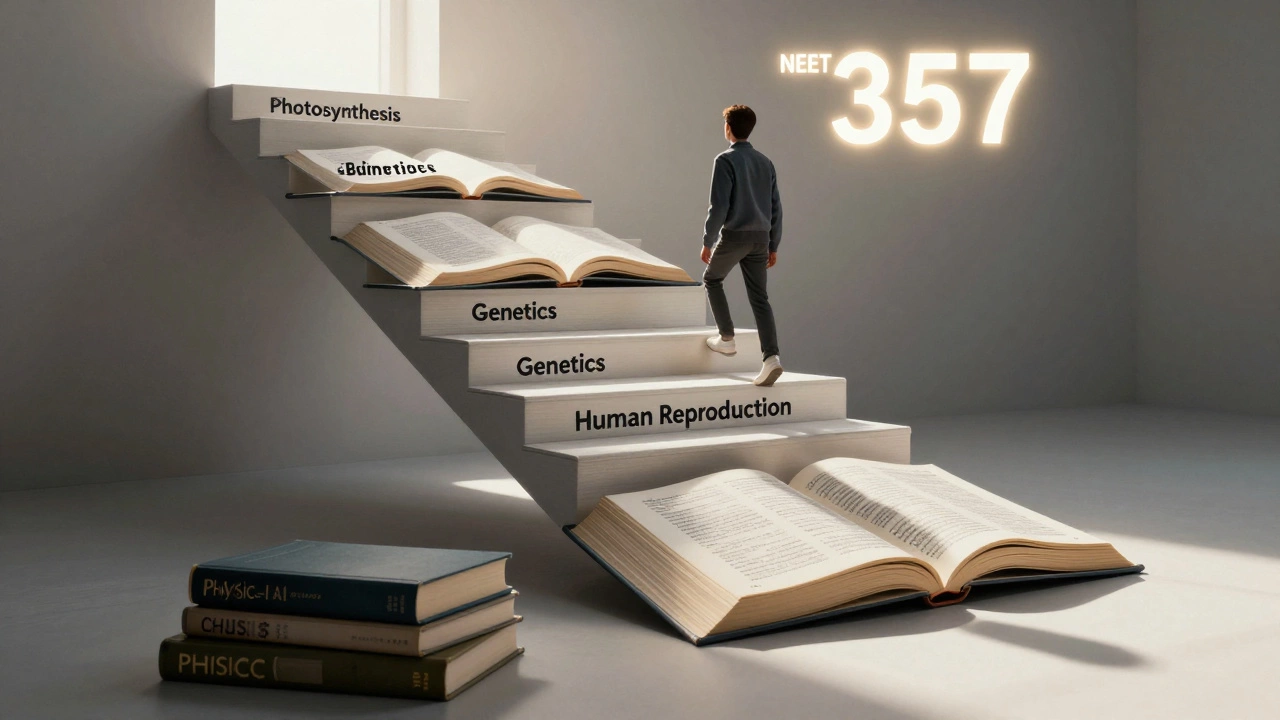
One student from Coimbatore scored 680/720 in NEET 2024. Her biology score? 357. Physics? 105. Chemistry? 218. She didn’t ace physics. She didn’t need to. She dominated biology.
What to Do If You’re Behind
If you’re starting late-or you’ve bombed a mock test-here’s your survival plan:
- Stop wasting time on physics derivations for now.
- Open NCERT Biology Class 11. Read one chapter a day. Use a timer: 45 minutes per chapter.
- After reading, write down 5 key points. Then answer 10 MCQs from a trusted app like NEET Prep or Allen’s question bank.
- Repeat for Class 12. By the end of 30 days, you’ll have covered the entire syllabus once.
- Now go back and read the same chapters again. This time, focus on diagrams and bolded lines.
- By Day 60, you’ll be scoring 300+ in biology mocks. That’s your foundation.
Once biology is locked in, you can breathe. Then you can tackle chemistry. Then, slowly, physics.
Final Reality Check
There’s no magic subject. But there is a smart strategy. Biology gives you the biggest bang for your buck. It’s not about what’s easy. It’s about what’s reliable.
NEET doesn’t test genius. It tests consistency. The subject that rewards daily effort the most is biology. If you treat it like your job-show up, read, revise, test-you won’t just pass. You’ll rank high.
Stop asking which subject is easiest. Start asking: "Which subject can I master first?" The answer is biology. And that’s your path to the top.
Is biology really the easiest subject in NEET?
Yes, for most students, biology is the easiest subject in NEET because over 90% of questions come directly from NCERT textbooks. It requires memorization and repetition, not complex problem-solving. With consistent daily study, students can score 320+ out of 360 in biology alone.
Can I skip physics if biology is easy?
No, you can’t skip physics. NEET requires you to clear the cutoff in all three subjects. But you can delay deep physics prep until you’ve secured strong marks in biology and chemistry. Focus on high-weightage physics topics like mechanics, electromagnetism, and modern physics after building your biology score.
How much time should I spend on biology daily?
Spend at least 2-3 hours daily on biology in the first 6 months of preparation. Break it into 45-minute blocks: read NCERT, make notes, solve 15-20 MCQs. By the end of Class 11, aim to have completed both Class 11 and 12 NCERT biology twice.
Is NCERT enough for NEET biology?
Yes, NCERT is enough for NEET biology. Past papers show that 75-85% of biology questions are directly from NCERT text or diagrams. Supplement with previous year questions and chapter-wise MCQs, but don’t overcomplicate with reference books unless you’re aiming for a top 100 rank.
Why do some students score low in biology even if it’s easy?
They treat it like a passive subject. Reading once isn’t enough. They skip diagrams, ignore bolded terms, and don’t revise. Biology rewards active recall. If you don’t test yourself daily with flashcards or quizzes, you’ll forget details like the exact number of cranial nerves or the structure of the nephron.
Next Steps for NEET Aspirants
Start today. Open your NCERT Biology Class 11 textbook. Read the first chapter on the living world. Write down three key points. Then find five MCQs online and answer them. That’s it. No grand plan. Just one chapter. One day.
Do that for 30 days. Then check your mock score. You’ll be shocked. Biology isn’t about talent. It’s about showing up. And that’s something you can control.