CBSE School Data Explorer (2026)
When you look at a map of India’s school landscape, one name dominates the conversation: CBSE. But if you ask which state actually has the highest number of these schools, the answer might surprise you. It isn’t the capital territory where everyone assumes the density is highest. It isn’t even the most populous state by default. The reality is shaped by migration patterns, government policy, and historical educational infrastructure.
In 2026, the data tells a clear story. While Delhi holds the crown for density, the sheer volume of schools belongs to a different region entirely. Understanding this distribution helps parents moving between cities, educators looking for job opportunities, and policymakers analyzing educational access. Let’s break down who leads the pack and why.
The Top Contender: Uttar Pradesh Takes the Lead
As of the latest affiliation records from the Central Board of Secondary Education, Uttar Pradesh hosts the highest absolute number of CBSE schools in the country. The numbers hover around 1,800 to 2,000 affiliated institutions. This surge wasn't accidental. It was driven by a middle-class aspiration for board exams that are perceived as easier to crack for national competitive tests like JEE and NEET. Parents in UP increasingly view CBSE not just as a curriculum, but as a gateway to central universities and defense services.
However, quantity doesn't always equal quality. While UP has the most schools, many are small-scale operations in rural belts. The infrastructure gap between a flagship school in Noida and a newly affiliated school in Basti remains wide. Yet, in terms of pure count, no other state can match the scale of UP's expansion.
The Density King: Why Delhi Looks Like the Winner
If you live in New Delhi, it feels like every third building houses a CBSE school. And statistically, your intuition is right-just not in total numbers. Delhi is a Union Territory, not a state, but it consistently ranks first in density of CBSE schools per square kilometer.
Why does Delhi feel so dominant? Because visibility matters. In Delhi, CBSE schools are often high-profile brands with large campuses and heavy marketing. In contrast, UP’s thousands of schools are spread out over a vast area, making them less visible in urban centers outside the National Capital Region (NCR). For a parent in Mumbai or Bangalore, Delhi represents the "standard" for CBSE education, skewing perception. But if you’re counting heads, Delhi trails behind Uttar Pradesh and Maharashtra.
The Strong Challengers: Maharashtra and Haryana
Behind the top two, the race gets tight. Maharashtra and Haryana form the next tier of CBSE-heavy regions. Both states have unique drivers for their high counts.
Mahashtra, particularly the Mumbai-Pune-Nagpur corridor, has seen a boom in CBSE affiliations. Mumbai alone accounts for hundreds of these schools. The state’s economic power drives a premium education market. Parents here often choose CBSE for its alignment with ICSE in terms of rigor but with the added benefit of national recognition. Maharashtra currently sits at around 1,100 to 1,200 affiliated schools. The growth here is steady, fueled by the IT sector’s demand for STEM-focused curricula, which CBSE emphasizes heavily in recent years.
Haryana is another powerhouse. Being a neighbor to Delhi, it shares similar educational aspirations. Cities like Gurgaon (Gurugram) and Faridabad have transformed into education hubs. Many schools in Haryana were established by developers targeting NCR commuters. With roughly 900 to 1,000 CBSE schools, Haryana punches above its weight. The state government also actively supports CBSE affiliations to attract talent and retain families within the state rather than letting them migrate to Delhi for schooling.
Regional Variations: South vs. North
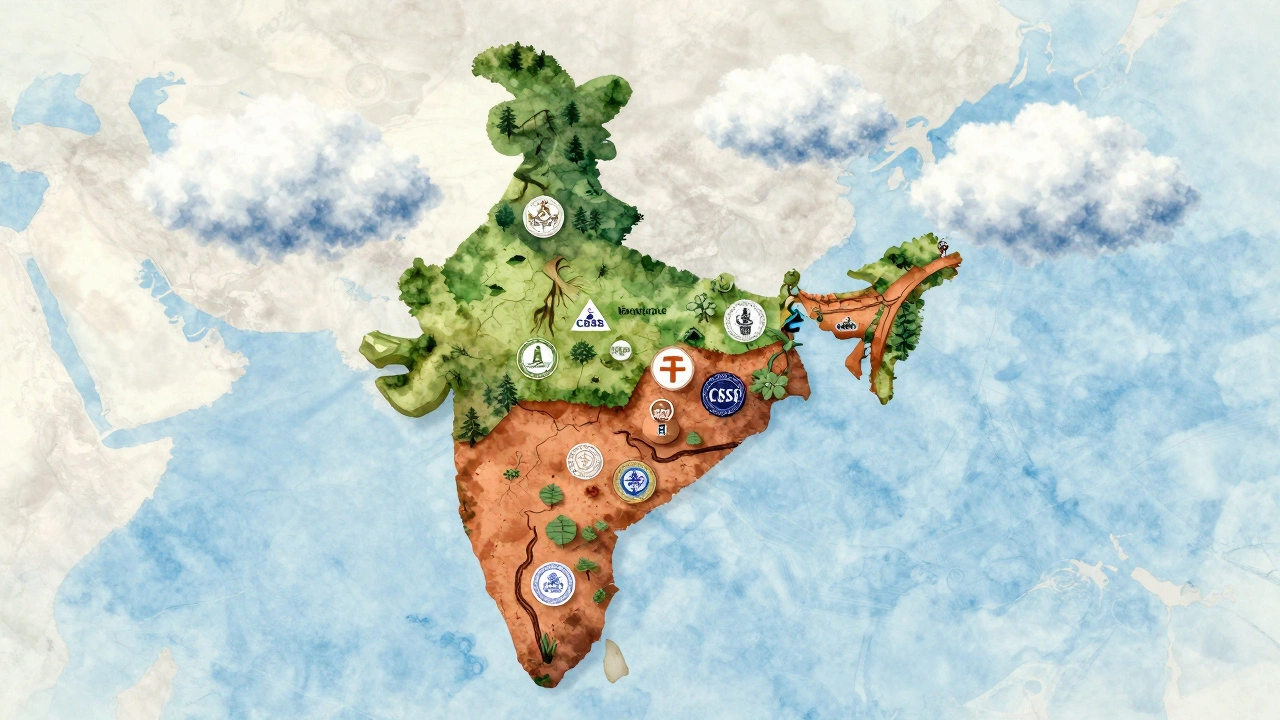
The map changes drastically when you cross into Southern India. States like Tamil Nadu, Karnataka, and Kerala have historically preferred their own state boards or the CISCE (ICSE) curriculum.
- Tamil Nadu: Known for its strong state board, TN has fewer CBSE schools, mostly concentrated in Chennai and Coimbatore. The count is under 500. The local culture values the Tamil Nadu State Board for its depth in science and mathematics, resisting the homogenization of national boards.
- Karnataka: Bangalore is an exception. As the tech capital, it attracts expatriates and migrants from all over India. Consequently, Bangalore has a high density of CBSE schools, pushing Karnataka’s total to around 600-700. Outside Bangalore, the preference shifts back to state boards or PUC systems.
- Kerala: With one of the highest literacy rates in the world, Kerala relies heavily on its state syllabus and the ICSE board. CBSE presence is minimal, largely limited to defense cantonments and a few private chains in Kochi and Thiruvananthapuram.
This regional divide highlights a key insight: CBSE dominance is correlated with migration and mobility. States with high internal migration (like Maharashtra, Haryana, and Delhi) see more CBSE adoption because students move frequently. States with stable populations (like Tamil Nadu and Kerala) stick to local boards.
Why Does the Number Matter?
You might wonder why we care about which state has more schools. It impacts three critical areas:
- Job Market for Teachers: If you are a teacher looking for employment, Uttar Pradesh and Maharashtra offer the highest volume of openings. However, competition in Delhi and Mumbai is fiercer due to the prestige factor.
- Admission Pressure: In states with fewer CBSE schools (like Bihar or Odisha), getting into a good CBSE institution can be incredibly difficult, leading to high fees and long waiting lists. In UP, while there are more schools, the population pressure keeps demand sky-high.
- Policy Influence: States with higher CBSE penetration have more leverage in negotiating curriculum updates with the central board. This influences how topics like environmental science or computer science are taught nationwide.
Data Snapshot: CBSE School Counts by State (Approximate 2026)
| Rank | State / UT | Estimated Count | Key Driver |
|---|---|---|---|
| 1 | Uttar Pradesh | ~1,850 | Population & Private Investment |
| 2 | Delhi (UT) | ~1,250 | Density & Central Government Presence |
| 3 | Maharashtra | ~1,150 | Economic Hub & Migration |
| 4 | Haryana | ~950 | NCR Proximity |
| 5 | Rajasthan | ~800 | Urban Expansion in Jaipur/Jodhpur |
| 6 | Karnataka | ~650 | Bangalore Tech Corridor |
| 7 | Gujarat | ~600 | Industrial Growth |
Note: These figures are based on public affiliation lists released by CBSE and may vary slightly depending on pending approvals or de-affiliations during the academic year. Rajasthan has quietly climbed the ranks due to rapid urbanization in Jaipur and Udaipur, challenging traditional leaders.
The Rise of Digital Affiliation
A new trend in 2026 is the digitization of school management. CBSE has pushed for all affiliated schools to use digital platforms for exam registration and result processing. This has led to a cleanup of data. Some "ghost schools" that existed only on paper in earlier years have been removed from the active list. This means the current numbers are more accurate than those from five years ago. It also means that smaller states like Punjab and West Bengal have seen slight corrections in their counts, though they remain mid-tier players with 400-500 schools each.
What Should Parents Consider?
If you are relocating, don’t just look at the number of schools. Look at the ecosystem. In Delhi, you have choices, but traffic and cost are barriers. In UP, you have volume, but you must vet infrastructure carefully. In Maharashtra, you get a mix of legacy institutions and modern setups. The best CBSE school isn’t necessarily in the state with the most schools; it’s the one that fits your child’s learning style and your logistical constraints.
Ultimately, the dominance of Uttar Pradesh in raw numbers reflects India’s demographic reality. As the center of gravity for population shifts eastward and northward, expect states like Bihar and Jharkhand to see increased CBSE affiliation requests in the coming years. The map is still changing.
Does Delhi have more CBSE schools than any state?
No. While Delhi has the highest density of CBSE schools per square kilometer, Uttar Pradesh has the highest total number of CBSE-affiliated schools due to its massive population and recent educational expansion.
Why are there fewer CBSE schools in Tamil Nadu?
Tamil Nadu has a strong tradition of using its own state board curriculum, which is highly respected for science and mathematics. Additionally, the ICSE board is popular there. CBSE schools exist mainly in major cities like Chennai but do not dominate the landscape as they do in the North.
Is it harder to get admission in CBSE schools in Delhi?
Yes, admission to top-tier CBSE schools in Delhi is highly competitive due to high demand and limited seats in premier institutions. However, the sheer number of options means there are alternatives, unlike in smaller towns where only one or two CBSE schools might exist.
How does CBSE compare to ICSE in terms of school numbers?
CBSE has significantly more affiliated schools than ICSE (CISCE) across India. CBSE focuses on broad accessibility and national standardization, while ICSE tends to be more concentrated in specific urban pockets and private institutions, resulting in a lower total count.
Are CBSE schools growing faster in Tier-2 cities?
Yes. The fastest growth in CBSE affiliations is happening in Tier-2 and Tier-3 cities in states like Uttar Pradesh, Rajasthan, and Madhya Pradesh. This is driven by rising middle-class aspirations and the desire for a curriculum that facilitates easy movement for higher education anywhere in India.