
MBA ROI & Payback Calculator
Your Financial Inputs
Analysis Results
| Scenario | Annual Net Income |
|---|---|
| No MBA (Status Quo) | $0 |
| With MBA | $0 |
Waiting for data...
Input your financial figures to receive a personalized assessment of your potential MBA investment.
There is no single "best" MBA program. That phrase is a trap. If you walk into any career counselor’s office and ask for the one perfect school, they will smile politely while knowing the truth: the best program depends entirely on who you are, where you want to go, and how much risk you can handle.
In 2026, the landscape of business education has shifted dramatically. The pandemic accelerated the acceptance of online formats, AI is reshaping curriculum requirements, and the traditional prestige hierarchy is being challenged by specialized micro-masters and executive tracks. So, how do you cut through the noise? You stop looking at general rankings and start looking at your specific job-to-be-done.
The Myth of the "Top Tier"
Most applicants obsess over the M7 Business Schools, which includes Harvard, Stanford, Wharton, Chicago Booth, Columbia, MIT Sloan, and Northwestern Kellogg. These schools dominate the headlines because their alumni networks are powerful and their brand recognition is global. But does attending Harvard make sense if you plan to work in regional healthcare management in Ohio? Probably not.
The "best" school is the one that aligns with your target industry and geography. If you want to break into Silicon Valley tech, Stanford GSB or Berkeley Haas offers proximity to venture capitalists and founders. If you aim for investment banking in New York, Columbia Business School or NYU Stern provides the recruitment pipeline. If you are targeting consulting globally, McKinsey and BCG recruit heavily from a broader pool of top-20 schools, not just the M7.
| Career Goal | Key Factor | School Examples (2026) |
|---|---|---|
| Tech Product Management | Location & Alumni Network | Stanford GSB, Berkeley Haas, MIT Sloan |
| Investment Banking | Recruiting Pipeline | Columbia, Wharton, NYU Stern |
| Management Consulting | Brand Prestige | Harvard, Chicago Booth, Northwestern Kellogg |
| Entrepreneurship | Venture Capital Access | Stanford, Babson, MIT Sloan |
| Healthcare Administration | Specialized Curriculum | Wharton, Duke Fuqua, University of Pennsylvania |
Calculating Real ROI, Not Just Salary
When evaluating an MBA, people often look at the median starting salary reported by schools. This number is misleading. To calculate true Return on Investment (ROI), you need to subtract the total cost of attendance-including tuition, fees, housing, and lost wages-from your expected lifetime earnings increase.
In 2026, the average tuition for a top-tier US MBA exceeds $150,000. When you add living expenses, the total cost often surpasses $200,000. If you graduate with a salary of $180,000 but carry $150,000 in debt, your financial freedom is delayed by years. Conversely, a lower-ranked school with a tuition of $60,000 might offer a similar net benefit if your local job market pays well and your living costs are low.
Ask yourself these questions:
- What is my current salary, and what is the opportunity cost of quitting?
- Does the school have a strong career services team in my target city?
- Are there scholarships or fellowships available for my profile?
- How long will it take to pay off student loans without sacrificing quality of life?
For example, a public university like the University of Michigan Ross or UNC Kenan-Flagler often provides exceptional ROI due to lower tuition and strong regional employer relationships. Don’t let the glamour of Ivy League names blind you to the math.
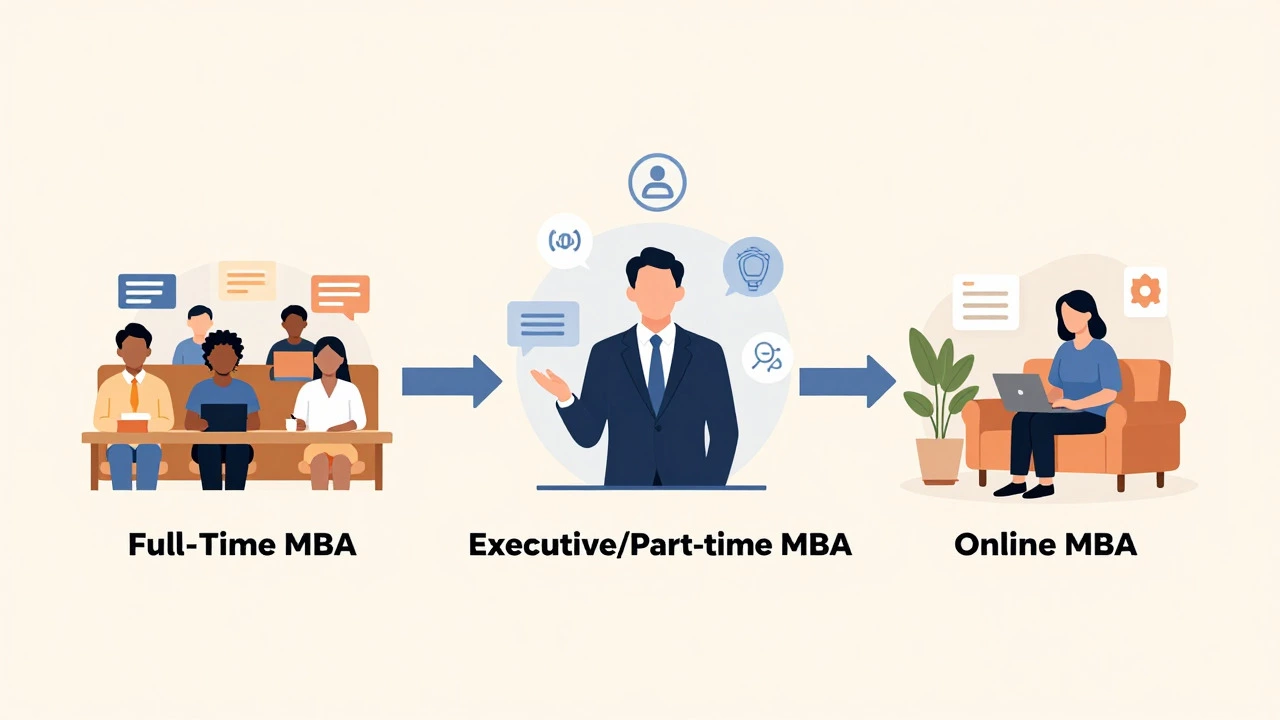
Full-Time vs. Part-Time vs. Online: Format Matters
The format of your MBA determines your lifestyle, network, and career trajectory. In 2026, the stigma around online MBAs has largely disappeared, especially for accredited programs from reputable institutions.
Full-Time MBA: This is the traditional two-year immersive experience. It allows for a complete career pivot, extensive networking, and internship opportunities. However, it requires a significant time commitment and financial sacrifice. It is ideal for early-career professionals (3-7 years of experience) who want to switch industries or functions.
Part-Time/Executive MBA: Designed for mid-career professionals (8+ years of experience) who want to advance within their current organization or industry. You keep your job, so there is no lost wage, but the workload is intense. Schools like Harvard Executive Education or Kellogg Executive MBA cater to this demographic. The network consists of peers with substantial experience, which can be valuable for leadership roles.
Online MBA: Programs from schools like Indiana Kelley, UT Austin McCombs, and Illinois Gies have gained credibility. They offer flexibility and lower costs but require self-discipline. The networking aspect is weaker unless you actively participate in virtual events and optional residencies. Choose this if you value flexibility and have a clear career path that doesn’t require a geographic move.
Curriculum: Generalist vs. Specialist
Not all MBAs are created equal in terms of content. Some schools emphasize a core curriculum with limited electives, forcing students to become generalists. Others allow deep specialization from day one.
If you know you want to specialize in finance, look for schools with strong quantitative rigor and CFA partnership tracks, such as Wharton or Chicago Booth. If you are interested in marketing, schools like Northwestern Kellogg or UCLA Anderson offer robust creative and analytical marketing courses. For technology management, MIT Sloan and Carnegie Mellon Tepper integrate coding and data science into their business curriculum.
In 2026, many top programs now include mandatory modules on artificial intelligence, sustainability, and global supply chain resilience. Ensure the curriculum reflects current business realities, not outdated theories.
Network Quality Over Brand Name
Your MBA network is your most valuable asset. A smaller, tight-knit alumni community can be more helpful than a massive, disconnected one. Look for schools with active alumni chapters in your target cities and industries. Attend information sessions and ask current students about alumni engagement. Do former graduates help with referrals? Do they mentor junior members?
Schools like Dartmouth Tuck or Yale SOM pride themselves on close-knit communities where alumni genuinely support each other. In contrast, larger schools may have more total alumni, but finding relevant connections can feel like searching for a needle in a haystack.

Admissions Strategy: Fit and Story
Getting into the "best" program is competitive. Admissions committees look for three things: academic ability (GPA, GMAT/GRE scores), professional achievement (work experience, promotions), and fit (culture match, leadership potential).
Your application essay should tell a coherent story. Why an MBA now? Why this school? How will you contribute to the classroom? Avoid generic statements. Be specific. Mention professors, clubs, or initiatives that attract you. Show, don’t just tell, your leadership skills through concrete examples.
Remember, admissions officers read thousands of applications. Stand out by being authentic and unique. Highlight unconventional experiences, diverse backgrounds, or niche expertise that adds value to the cohort.
Alternatives to Traditional MBA
An MBA is not the only path to career advancement. Consider these alternatives:
- Master of Science in Management (MSM): For younger candidates with less work experience. Focuses on foundational business skills.
- Specialized Master’s Degrees: MS in Finance, Data Analytics, or Marketing. Provides deep technical expertise without the breadth of an MBA.
- Certifications: PMP for project management, CFA for finance, CPA for accounting. Lower cost and faster completion.
- Micro-Masters: Short, focused online courses from platforms like edX or Coursera, often stackable into a full degree.
Evaluate whether you need the comprehensive business education and network of an MBA, or if a targeted credential suffices for your goals.
Final Checklist Before Applying
Before submitting applications, run through this checklist:
- Define your post-MBA career goal clearly.
- Research schools that recruit in your target industry and location.
- Calculate total cost and projected ROI.
- Assess format fit (full-time, part-time, online).
- Review curriculum for relevance to your interests.
- Contact current students and alumni for honest feedback.
- Prepare a compelling narrative for your essays.
Choosing an MBA is a major life decision. Take your time, do your homework, and choose the program that empowers you to achieve your specific ambitions. There is no universal best-only the best for you.
Is an MBA worth it in 2026?
An MBA remains valuable for career pivots, leadership acceleration, and network building, but its ROI varies. Top-tier programs offer high returns for those entering finance, consulting, or tech leadership. For others, specialized master’s degrees or certifications may provide better value. Calculate your personal ROI based on tuition, lost wages, and expected salary increase.
What is the difference between an MBA and an EMBA?
An MBA is typically for early-career professionals seeking to change careers or accelerate growth, involving full-time study. An Executive MBA (EMBA) is designed for experienced leaders (8+ years) who continue working while studying. EMBAs focus on strategic leadership and peer learning among senior executives, with higher tuition but no lost income.
Do online MBAs hold the same value as on-campus programs?
Accredited online MBAs from reputable schools (e.g., Indiana Kelley, UT Austin) are increasingly respected, especially for career advancement within current industries. However, they may lack the immersive networking and career switch opportunities of on-campus programs. Value depends on your goals: online is great for flexibility and upskilling; on-campus is better for pivoting and deep network building.
How important are GMAT/GRE scores for MBA admissions?
GMAT/GRE scores remain important for top-tier schools, serving as a standardized measure of academic readiness. Strong scores can compensate for a lower GPA, while weak scores may hinder admission unless offset by exceptional work experience. Some schools are test-optional, but submitting a strong score still strengthens your application.
Which MBA specialization has the highest salary potential?
Finance, consulting, and technology management typically offer the highest starting salaries post-MBA. Roles in investment banking, private equity, and product management command premium compensation. However, long-term earnings depend on performance, industry trends, and geographic location, not just specialization.