
Government Salary Estimator
Role Title
Pay LevelEstimated Monthly Income
Estimated Annual Package
Income Breakdown
- Basic Pay: ₹0
- Allowances & Perks: ₹0
Select a service and career stage to see estimated earnings.
You’ve spent years studying for competitive exams. You’ve memorized history dates, solved complex math problems, and practiced essay writing until your hand cramped. Now you’re asking the big question: which government position pays the most? It’s a fair question. When you invest that much time and effort, you want to know where the financial reward lies.
The short answer isn’t just one job title. It depends on whether you are looking at entry-level salaries or peak career earnings. Generally, the highest-paying roles belong to the All India Services (IAS, IPS, IFS) and the top technical services like the Indian Engineering Services (IES). However, there is a catch. The 'pay' includes basic salary, allowances, and perks that vary wildly depending on where you are posted and what level of authority you hold.
The Hierarchy of Pay: Understanding the Pay Matrix
To understand who gets paid the most, you first need to understand how government pay works. Since the 7th Central Pay Commission was implemented in 2016, all central government employees fall under a specific pay matrix. This system replaced the old pay bands and grade pay structure with a single table that determines your basic pay based on your level and years of service.
For the top-tier civil services, the starting point is Level-10 of the Pay Matrix. This means an entry-level IAS officer starts with a basic pay of ₹56,100 per month. But here is the key: this is only the base. The real money comes from the allowances added on top of this base. These allowances can double or even triple your take-home salary depending on your location and role.
As you climb the ladder, you move up the levels. An IAS officer typically reaches Level-18 (Cabinet Secretary) after 30+ years of service. At this peak, the basic pay alone is ₹2,50,000 per month. When you add the various allowances, the total monthly compensation for a Cabinet Secretary can exceed ₹4 lakhs. That is significantly higher than most private sector CEO packages when you factor in job security and benefits.
The Big Three: IAS, IPS, and IFS
When people ask about the highest-paying government jobs, they are usually referring to the three elite services: the Indian Administrative Service (IAS), the Indian Police Service (IPS), and the Indian Foreign Service (IFS). These are recruited through the UPSC Civil Services Examination, which is widely considered the toughest exam in India.
Indian Administrative Service (IAS) is the premier civil service of India responsible for administration and policy implementation. Also known as Civil Services, it places officers in critical roles like District Magistrate and Chief Secretary. Officers enjoy high social status and substantial financial rewards through housing, transport, and medical allowances.Let’s break down why these three stand out:
- IAS Officers: They handle general administration. Their salary is boosted by Dearness Allowance (DA), House Rent Allowance (HRA), and Travel Allowance. If you are posted in a metro city like Chennai or Mumbai, the HRA can be quite significant. Additionally, they get free or subsidized housing, official vehicles with drivers, and domestic help provided by the state.
- IPS Officers: They manage law and order. Their pay structure is similar to IAS, but they often receive additional risk-based allowances. For example, officers handling high-profile cases or working in disturbed areas may get special compensatory allowances. The physical nature of the job also comes with specific health and insurance benefits.
- IFS Officers: They represent India abroad. This is where the pay gets interesting. While their basic salary is the same as IAS/IPS, they receive Hardship Allowances if posted in difficult countries, and Cost of Living Allowances in expensive cities like New York or London. They also get tax-free income in many host countries and free diplomatic housing.
Technical Services: The Hidden High Earners
Most aspirants focus on the administrative services, but the technical services often offer comparable or even better financial packages, especially early in the career. The Indian Engineering Services (IES), Indian Forest Service (IFoS), and Indian Revenue Service (IRS) are recruited through separate exams conducted by UPSC or other bodies.
Indian Engineering Services (IES) is a Group A engineering service that recruits engineers for central government departments. Also known as Group A Engineering Services, it covers branches like Civil, Mechanical, Electrical, and Electronics. IES officers start at Level-10 but can rise to Level-17 (Director General) with specialized technical expertise commanding high respect and pay.Consider the Indian Revenue Service (IRS). Officers in the Customs and Indirect Taxate branch deal with billions in revenue. While their base pay is standard, the responsibility and the potential for performance-linked incentives in certain roles make them highly lucrative. Plus, the IRS has a very structured promotion path, ensuring steady increments without the political volatility sometimes faced by field administrators.
The Indian Air Force (IAF) and Indian Navy also have high-paying roles, particularly for pilots and technical specialists. An Air Commodore or a Captain in the Navy earns a basic pay of around ₹1,44,200 to ₹2,50,000 depending on rank, plus massive allowances for flying duties, mess facilities, and uniform maintenance. If you love the military lifestyle, these roles offer some of the best value-for-money packages in the public sector.

Allowances: The Real Game Changer
If you look only at basic salary, you miss half the picture. In government jobs, allowances can constitute 40-60% of your total income. Here are the major ones that boost your paycheck:
| Allowance Type | Description | Impact on Salary |
|---|---|---|
| Dearness Allowance (DA) | Inflation-adjusted allowance revised twice a year | Can reach 50%+ of basic pay during high inflation |
| House Rent Allowance (HRA) | Varies by city class (X, Y, Z) | Up to 24% of basic pay in metro cities like Chennai |
| Travel Conveyance Allowance (TCA) | For official travel and personal commute | Fixed amount based on rank; essential for mobility |
| Medical Reimbursement | Covers hospitalization and treatment costs | Saves thousands annually on healthcare expenses |
| Special Compensatory Allowance | For risky or remote postings | Significant boost for IPS/IFoS in tough terrains |
For instance, an IAS officer posted in a rural district might get a lower HRA but could receive a Special Area Allowance if the region is classified as difficult. Conversely, an officer in a metropolitan zone gets higher HRA but faces higher living costs. The net effect is that your disposable income remains relatively stable regardless of posting, which is a huge advantage over private sector jobs where relocation often means a pay cut or increased expenses.
Non-Monetary Perks: The Hidden Wealth
Money isn’t just cash in your bank account. It’s also what you don’t have to spend. Government officials enjoy perks that save them lakhs every year. Let’s talk about housing. An IAS officer doesn’t pay market rent for a spacious bungalow or apartment in prime locations. This alone saves ₹50,000 to ₹1,00,000 per month in cities like Mumbai or Delhi.
Then there’s healthcare. The Central Government Health Scheme (CGHS) covers almost all medical expenses for the officer and their family. In a country where health insurance claims can be a nightmare, having access to top hospitals without worrying about bills is priceless. Retirement benefits are another huge factor. Unlike the private sector where you rely solely on PF and NPS, government pensioners receive a defined benefit pension that guarantees income for life. This long-term financial security is worth millions in present value.
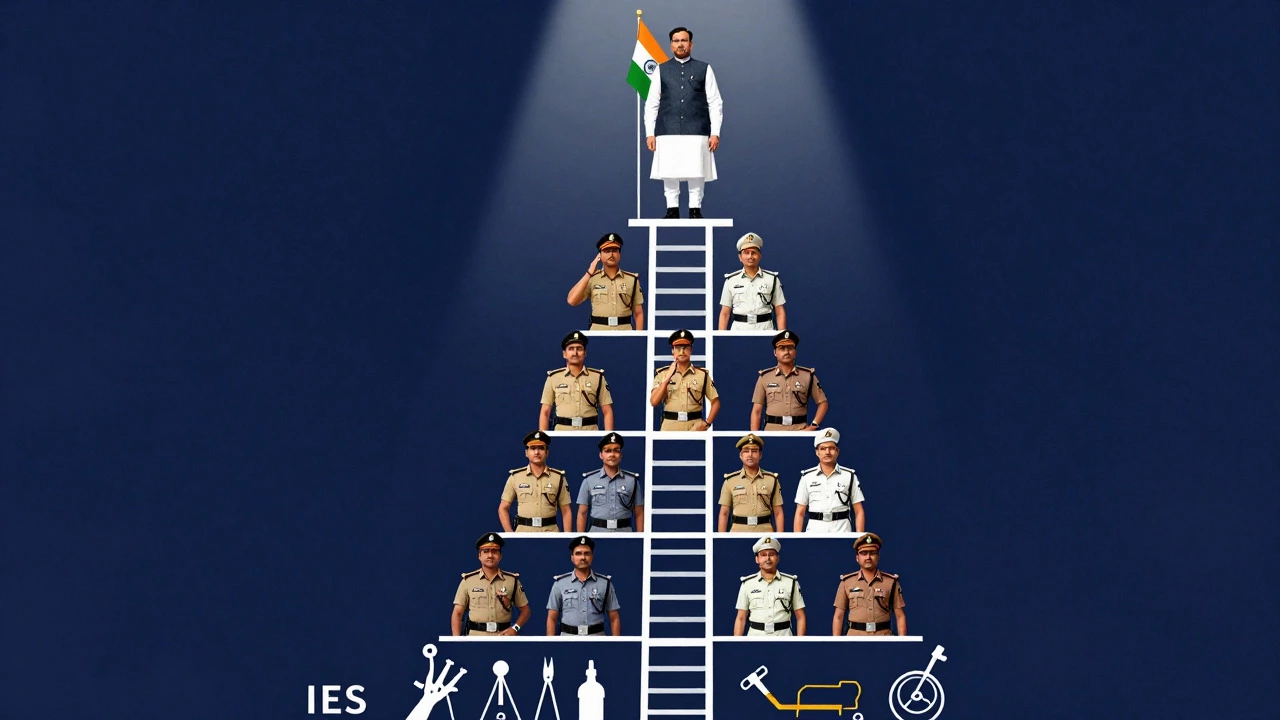
Comparison Table: Top Government Roles
To give you a clearer picture, let’s compare the approximate annual package (including allowances and perks) for top roles at different stages of their career.
| Service/Role | Entry-Level (Year 1-3) | Mid-Career (10-15 Years) | Peak Career (30+ Years) |
|---|---|---|---|
| IAS Officer | ₹12-15 Lakhs | ₹25-35 Lakhs | ₹50-60 Lakhs+ |
| IPS Officer | ₹12-15 Lakhs | ₹25-35 Lakhs | ₹50-60 Lakhs+ |
| IFS Officer | ₹15-20 Lakhs* | ₹30-40 Lakhs* | ₹60-80 Lakhs* |
| IES Officer | ₹12-14 Lakhs | ₹22-30 Lakhs | ₹45-55 Lakhs |
| IRS Officer | ₹12-14 Lakhs | ₹24-32 Lakhs | ₹48-58 Lakhs |
Note that these figures are estimates. Actual take-home pay varies based on individual circumstances, postings, and current government policies. However, the trend is clear: the All India Services dominate the top end of the salary spectrum.
Is the Money Worth the Stress?
High pay comes with high pressure. An IAS officer dealing with a natural disaster or a communal riot is under immense stress. An IPS officer managing crime rates in a bustling city like Chennai faces constant scrutiny. The work-life balance is often poor, especially in the early years when you are doing training and initial postings.
You also face political interference and bureaucratic hurdles. The power you wield can attract enemies as well as friends. So, while the salary is attractive, the emotional toll can be high. Many officers choose to retire early or switch to advisory roles in the private sector once they hit mid-career, leveraging their experience for consulting fees that rival their government salaries.
How to Prepare for These Top Roles
If you are determined to aim for these high-paying positions, preparation needs to be strategic. For IAS, IPS, and IFS, you must crack the UPSC Civil Services Exam. This requires a deep understanding of Polity, Economy, History, Geography, and Current Affairs. Start building a habit of reading newspapers like The Hindu or Indian Express daily. Analyze editorials to understand multiple perspectives on issues.
For technical services like IES, focus intensely on your core engineering subjects. Solve previous years’ question papers and practice numerical problems regularly. Joining a coaching institute in hubs like Chennai or Delhi can provide structured guidance, but self-study with the right resources is equally effective if you are disciplined.
Remember, consistency beats intensity. Studying 6 hours every day for two years is better than studying 12 hours for two months and burning out. Create a realistic study plan, stick to it, and stay updated with current events. The competition is fierce, but the reward-both financial and societal-is unmatched.
What is the highest salary in the Indian government?
The highest salary belongs to the Cabinet Secretary, who is the senior-most civil servant in India. With a basic pay of ₹2,50,000 per month and various allowances, the total monthly compensation can exceed ₹4 lakhs. Other top earners include the Chief Justice of India and the President of India, though their remuneration structures differ slightly.
Does an IAS officer earn more than an IPS officer?
Financially, IAS and IPS officers at the same level earn roughly the same basic salary and allowances. However, IPS officers may receive additional risk-based allowances depending on their posting. In terms of non-monetary perks, both enjoy similar benefits like housing, transport, and medical care. The difference often lies in the nature of work rather than the paycheck.
Are government jobs better paid than private sector jobs?
It depends on the role and industry. Entry-level government jobs may pay less than top tech or finance roles in the private sector. However, government jobs offer superior job security, pension benefits, and work-life balance in later stages. The total cost-to-company (including perks) often makes government roles more lucrative over a 30-year career span compared to volatile private sector jobs.
Which exam offers the highest return on investment?
The UPSC Civil Services Exam is generally considered to have the highest ROI due to the prestige, power, and financial stability it offers. Cracking this exam opens doors to IAS, IPS, and IFS, which are among the most respected and well-compensated careers in India. The initial investment in preparation is high, but the lifelong benefits justify it for many aspirants.
Do IFS officers really earn more than IAS?
Yes, often. IFS officers receive hard area allowances, cost-of-living adjustments, and tax exemptions in many foreign countries. These benefits can significantly boost their disposable income compared to IAS officers posted in India. However, the trade-off is frequent relocation and being away from family for extended periods.