Skill Pathway Finder
Find Your Skill Pathway
Discover skill training programs that match your interests and location. This tool suggests government-recognized programs with high job placement rates.
Enter your information above to see suggested programs
Back in the day, if you heard someone say "vocational education," you probably pictured a dusty workshop with teens learning to fix engines or sew clothes. That image isn’t wrong-but it’s outdated. Today, vocational education doesn’t look like that anymore. It’s not just about trades. It’s not just for students who "didn’t do well in school." It’s a fast-growing, high-value path that millions of young people are choosing-especially in places like India, where jobs are shifting faster than ever.
It’s Not Called "Vocational Education" Anymore
If you walk into a government training center, a private institute, or even a college campus today, you won’t hear the phrase "vocational education" much. You’ll hear terms like:
- Career and Technical Education (CTE)
- Skill-Based Training
- Technical and Vocational Education and Training (TVET)
- Diploma in Applied Skills
- Industry-Integrated Programs
Why the change? Because "vocational" got stuck with old baggage. People thought it meant low-status, low-paying jobs. The new names? They’re designed to sound professional, respected, and connected to real careers. "Career and Technical Education" makes it clear: this path leads to a job, not just a certificate.
What’s Actually Taught Today?
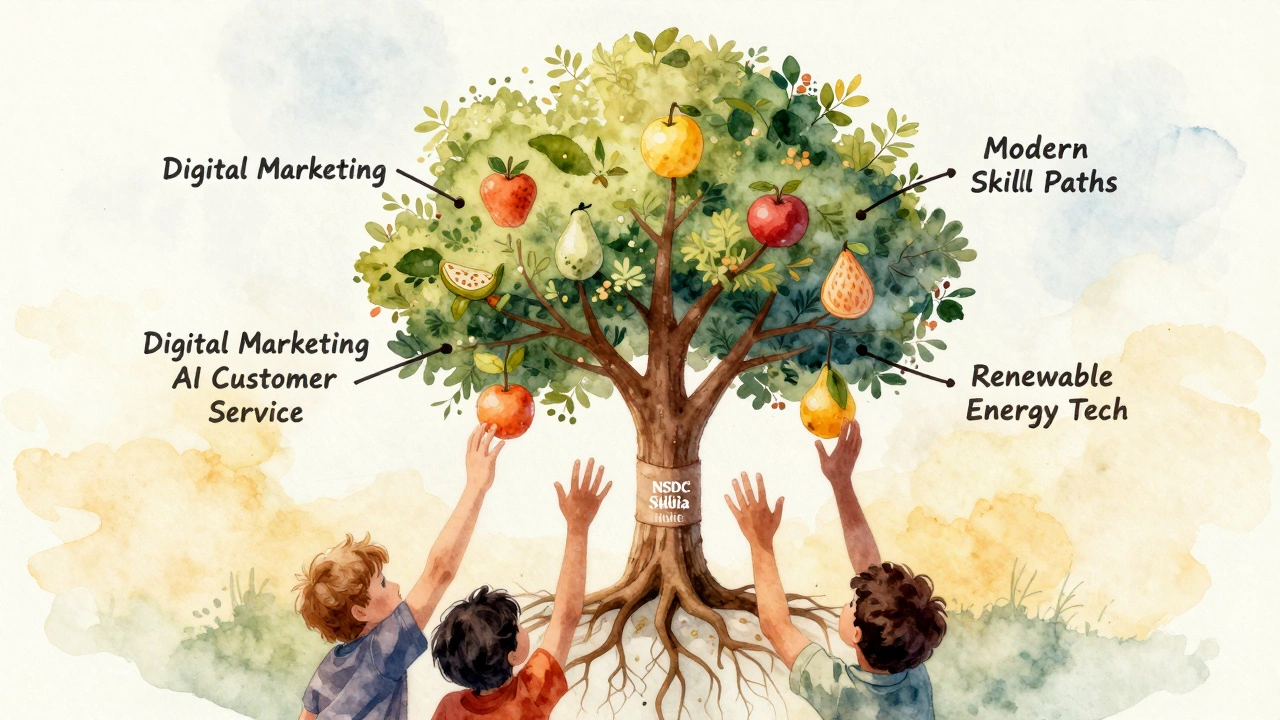
Forget just welding and tailoring. Today’s skill-based training covers fields you might not expect:
- Digital Marketing - Learn SEO, Google Ads, social media analytics
- Cybersecurity Basics - Network protection, phishing detection, firewall setup
- Healthcare Support - Medical billing, phlebotomy, ECG operation
- Renewable Energy Tech - Solar panel installation, battery maintenance
- Food Processing & Hygiene - FSSAI-certified food safety standards
- Logistics and Warehousing - Inventory software, supply chain tracking
- AI-Assisted Customer Service - Chatbot management, CRM tools
In Chennai alone, over 120 government-approved skill centers now offer courses in these areas under the National Skill Development Corporation (NSDC). These aren’t theoretical classes. Students train on actual machines, use real software, and often complete internships with companies like Tata Motors, Amazon, or Apollo Hospitals.
Who’s Running These Programs?
It’s not just colleges anymore. The ecosystem has changed:
- Government - NSDC, Ministry of Skill Development and Entrepreneurship (MSDE), and state skill missions
- Private Institutes - Aptech, NIIT, and regional players like Skill India Academy in Tamil Nadu
- Industry Partners - Companies like Infosys, Reliance, and Flipkart design curricula and hire directly from their training programs
- Online Platforms - SWAYAM, NIOS, and Coursera now offer accredited skill certificates
Many of these programs are funded by the government. If you’re between 15 and 35, you can often enroll for free-or pay as little as ₹500 for a 3-month course that leads to a job.

Why the Shift? The Job Market Changed
In 2015, India had a shortage of 20 million skilled workers. By 2025, that number has jumped to over 45 million, according to the World Economic Forum’s Future of Jobs Report. Why? Because automation and digital tools are replacing routine jobs-but creating demand for people who can operate, maintain, and manage them.
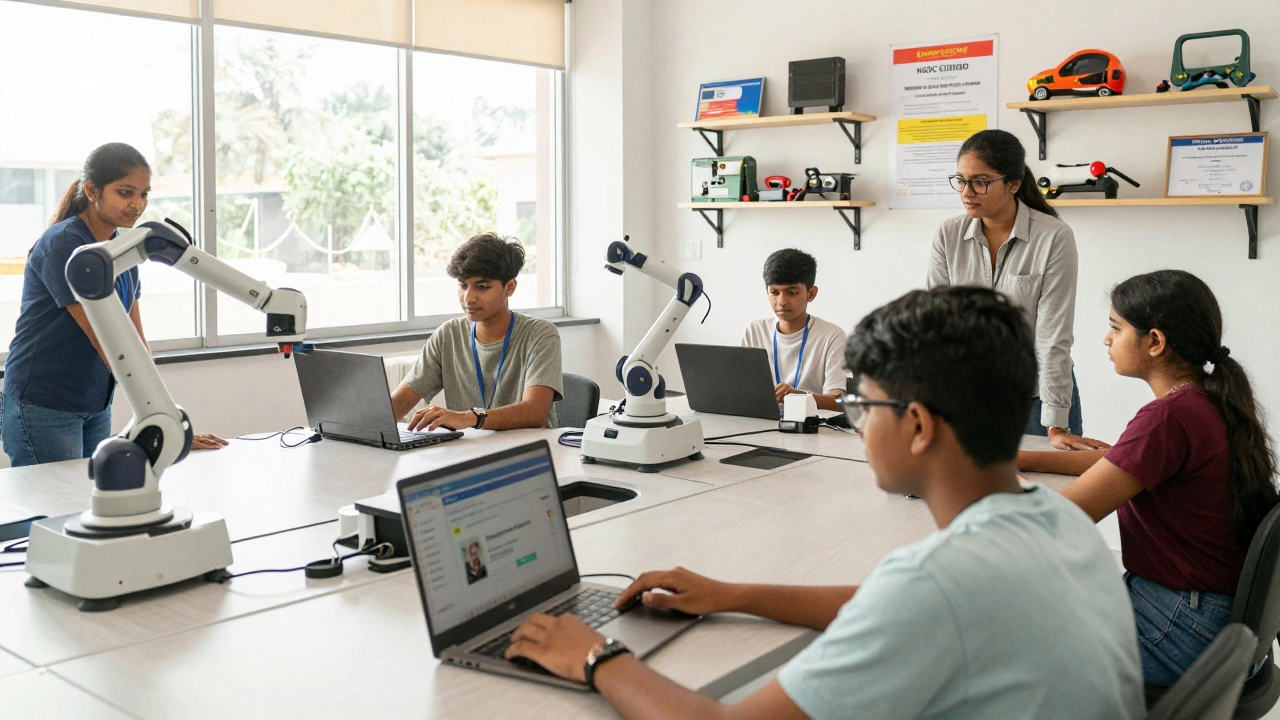
Take this example: A factory in Hosur, near Bangalore, used to hire 50 workers for manual assembly. Now, it hires 12 workers-but they all need to know how to program and troubleshoot robotic arms. These aren’t engineers with degrees. They’re people who completed a 6-month Industrial Automation Diploma from a nearby NSDC partner.
Companies don’t want graduates who can recite theory. They want people who can plug in a machine, fix a glitch, and log data by day two. That’s what modern skill training delivers.
How Do You Know It’s Legit?
With so many new names and programs, how do you avoid scams? Look for these signs:
- NSDC or NCVT certification - Check if the course is listed on skillindia.gov.in
- Industry partnership - Does the institute mention actual companies they work with? (e.g., "Certified by TCS")
- Placement record - Ask for last year’s job placement stats. Legit programs show numbers: "87% placed in 3 months"
- Government funding - If it’s free or heavily subsidized, it’s likely part of a public initiative
Watch out for institutes that promise "guaranteed jobs" or charge over ₹10,000 for a 2-month course. Real skill training is practical, not flashy.
What About College? Do You Still Need a Degree?
No. Not anymore. In fact, many students are choosing skill training instead of a 3-year degree.
Here’s a real case: A 17-year-old from Tirunelveli finished 10th grade and joined a 9-month Diploma in Retail Management through a government center. She learned inventory software, customer service protocols, and POS system handling. After 3 months of internship at a Reliance Retail store, she was hired as a store assistant at ₹18,000/month. Her cousin, who went to college for a BA in Commerce, is still looking for an internship.
That’s not rare. In 2024, the National Sample Survey found that 68% of skill-trained youth got jobs within 6 months-compared to 41% of degree holders in non-technical fields.
What’s Next? The Future of Skill Training
The next wave is personalization. Instead of one-size-fits-all courses, you’ll see:
- Micro-credentials - Earn a badge for mastering Excel pivot tables or basic Python scripting
- Stackable certifications - Start with digital literacy, then add AI tools, then data analysis
- Hybrid learning - 2 days a week at a center, 3 days learning online with AI tutors
- Employer-led training - Companies like Zomato and Ola now train people directly for their roles
By 2027, the Indian government plans to train 500 million people in skills. That’s not a fantasy-it’s a plan. And it’s already working in cities like Chennai, Coimbatore, and Vijayawada, where skill centers are now as common as tuition classes.
Where Do You Start?
Here’s how to begin today:
- Go to skillindia.gov.in and enter your location
- Choose a sector: IT, healthcare, retail, manufacturing, or hospitality
- Filter by duration: 1 month, 3 months, 6 months
- Check if it’s NSDC-certified and free
- Visit the center. Ask to see the equipment and talk to past students
No entrance exam. No high school marks required. Just willingness to learn.
Is This For You?
If you’re:
- Looking for a job fast
- Not interested in sitting through 3 years of theory
- Willing to learn by doing
- Worried about the cost of college
Then this isn’t a backup plan. It’s the best plan.
Is vocational education the same as technical education?
They’re closely related but not identical. Technical education usually refers to engineering and IT fields with more theory-like a diploma in mechanical engineering. Vocational or skill-based training focuses on hands-on job readiness, like fixing air conditioners or managing a retail store. Today, "technical" is often used for higher-level roles, while "vocational" has been replaced by "skill-based" or "career and technical education" to avoid old stereotypes.
Can I get a government job after vocational training?
Yes, absolutely. Many state government jobs-like sanitation supervisor, lab assistant, electrician in public hospitals, or warehouse operator in state food corporations-require only skill certifications, not degrees. The Tamil Nadu government, for example, has reserved over 15% of entry-level posts for NSDC-certified candidates. You’ll still need to clear a written test, but your certification gives you a direct advantage.
Are online vocational courses worth it?
Some are, some aren’t. Look for courses that are part of the SWAYAM platform or offered by NSDC-approved partners like NIOS or IGNOU. Free courses on YouTube or Udemy usually don’t come with recognized certificates. A legit online skill course will give you a government-recognized credential, practical assignments, and sometimes even an internship tie-up. Always check the certification body before enrolling.
Do employers take vocational training seriously?
Yes, more than ever. Companies like Amazon, Flipkart, and Tata Steel now list skill certifications as equal to degrees in their hiring filters. In 2024, Infosys hired over 12,000 people with NSDC certifications for roles like data entry operators, customer support agents, and logistics coordinators. The key is the certification’s credibility-not the name "vocational." If it’s NSDC or NCVT-certified, employers recognize it.
Can I switch from vocational training to college later?
Yes, and many do. The National Education Policy 2020 allows students with skill certifications to enter degree programs with advanced standing. For example, someone with a 1-year certificate in computer applications can join a BCA program in the second year. Some universities even give credit for prior training. It’s a smart way to build experience first, then add academic credentials later.
If you’re reading this and thinking, "I’m too old," or "I didn’t do well in school," remember: the old system left millions behind. The new system was built for people like you. No judgment. No barriers. Just a path to a job-and a future you can actually touch.