Physics Visualization Simulator
Master Physics Visualization
CBSE Physics demands visual understanding. This tool helps you see magnetic fields in action—the key to solving application-based questions.
Why this matters: CBSE papers have 68% application-based questions. Students who can visualize field lines score 23% higher on case studies.
Why This Matters for CBSE Exam
When you can visualize magnetic fields, you solve exam questions like this:
"A solenoid carries current. Describe how field lines change if current direction is reversed."
This is exactly the type of application-based question in CBSE papers. Understanding field visualization helps you:
- Answer diagram-based questions correctly
- Visualize concepts like Lenz's Law
- Solve situational problems in 3-4 minutes
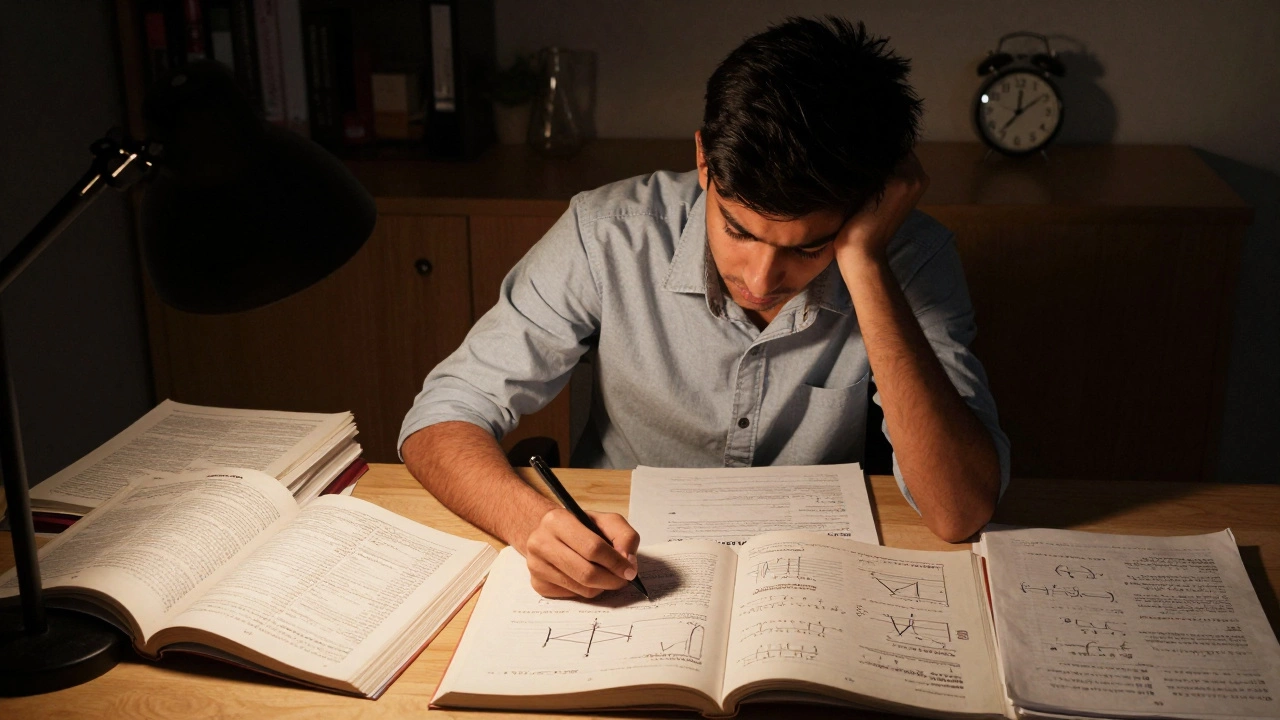
Ask any Class 12 student in India preparing for CBSE boards, and they’ll tell you one subject makes their stomach twist every time they open a textbook: Physics. Not because it’s full of abstract theories, but because it’s the subject where theory, math, and real-world application collide-hard.
Let’s be clear: this isn’t about who’s smarter. It’s about structure. The CBSE Class 12 Physics syllabus doesn’t just test knowledge. It tests how fast you can switch between formulas, diagrams, derivations, and numerical problem-solving-all under timed pressure. And it’s not just hard because it’s complex. It’s hard because it’s designed to separate the memorizers from the thinkers.
Take electrostatics. You learn Coulomb’s Law. Sounds simple, right? But then you’re asked to find the electric field at a point due to a dipole placed at an angle in a non-uniform field. That’s not a one-step problem. It’s a three-step puzzle with trigonometry, vector analysis, and unit conversions wrapped in one question. And that’s just Unit 1.
Compare that to Chemistry. Organic reactions? Yes, there are a hundred mechanisms to remember. But once you learn the pattern-nucleophilic substitution, electrophilic addition-you can solve most questions by following a flowchart. Inorganic? Memorize the periodic table trends and transition metal colors. You don’t need to derive anything. Just recall.
Math? It’s brutal, no doubt. Calculus problems can stretch across pages. But math gives you clear rules. If you apply the right formula, you get the right answer. Physics doesn’t work like that. You need to understand the *why* behind the formula. Why is the time period of a pendulum independent of mass? Why does a capacitor block DC but pass AC? If you can’t explain it in your own words, you’ll get stuck on even the simplest numerical.
And then there’s the exam pattern. CBSE Physics papers are built around application. In 2025, over 68% of the paper was based on situational problems, case studies, and diagram-based questions. You won’t find a single direct ‘define Newton’s first law’ question. Instead, you’ll get: ‘A car accelerates on a wet road. Explain why the friction force changes and how it affects stopping distance.’ That’s not memorization. That’s reasoning under pressure.
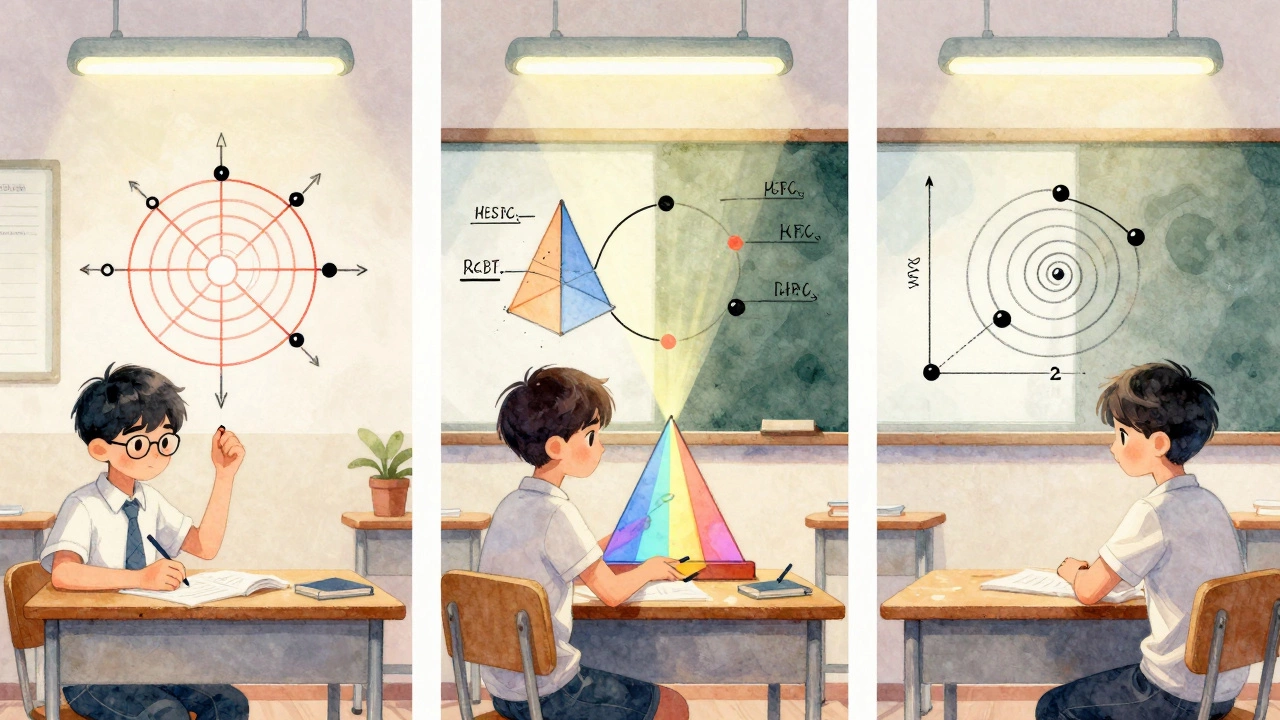
Students who ace Math often struggle in Physics because they think it’s just ‘Math with units.’ It’s not. Physics asks you to visualize. You need to imagine magnetic field lines bending around a wire. Picture how a charged particle spirals in a magnetic field. Sketch the path of light through a prism. If you can’t draw it, you can’t solve it.
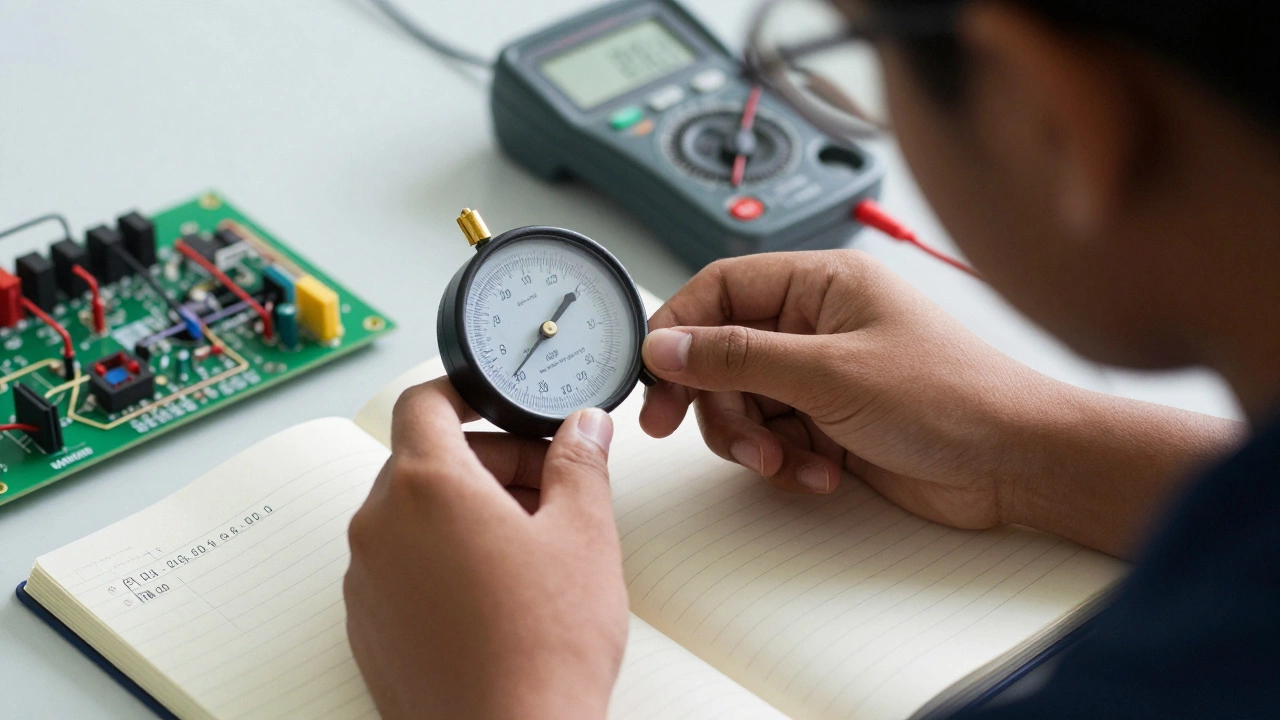
Here’s what makes it worse: the lab component. CBSE requires 15 marks for practicals. You don’t just write the experiment. You must set up the circuit, calibrate the galvanometer, record readings with correct significant figures, and calculate percentage error. One wrong decimal place, and you lose marks. No second chances.
And don’t get me started on the weightage. Electromagnetism and Optics together make up nearly 40% of the paper. That’s two units packed with formulas like Faraday’s Law, Snell’s Law, lensmaker’s formula, and interference conditions. You can’t skip one and hope to pass. You have to master all of them.
Some say Math is harder because of the length of problems. Others say Chemistry is harder because of the volume. But here’s the truth: Physics is the only subject where you can study for 100 hours, solve 50 practice papers, and still freeze during the exam because the question looked different. It doesn’t care how much you memorized. It cares how well you think.
Real students in Chennai, Delhi, and Lucknow tell the same story: they spent weeks on Physics, stayed up till 2 a.m. solving problems from HC Verma and NCERT Exemplar, and still felt unprepared. Why? Because Physics doesn’t reward effort alone. It rewards understanding. And understanding takes time-time most students don’t have with five other subjects to manage.
There’s no magic trick. No shortcut. No ‘top 10 formulas’ list that will save you. The only way through Physics is to stop treating it like a subject and start treating it like a language. Learn its grammar (formulas), its vocabulary (terms like flux, permittivity, refractive index), and its rhythm (how concepts connect). Then, practice translating real-life situations into physics problems.
One student from a government school in Tiruppur told me: ‘I used to cry over Physics. Then I started explaining it to my younger brother. If I could teach it to him, I knew I understood it.’ That’s the key. Teaching is the fastest way to learn. If you can explain Lenz’s Law without a textbook, you’ve got it.
And yes, this is based on data. A 2024 CBSE analysis showed that Physics had the lowest average score among all Class 12 subjects-just 58.7%. Math was at 63.2%. Chemistry at 67.1%. English? 78.9%. The gap isn’t small. It’s structural.
So is Physics really the number 1 hardest subject? Yes. Not because it’s the most advanced. Not because it’s the most theoretical. But because it’s the only one that forces you to think, visualize, calculate, and explain-all at once. And in a system that measures you by marks, that’s the hardest thing of all.
Why Physics Beats Math and Chemistry in Difficulty
Math is predictable. You see a quadratic equation? You apply the formula. You see an integral? You recognize the pattern. There’s a right path. Physics? You get a question about a sliding block on an inclined plane with friction, and you have to decide: Do I use energy conservation? Or Newton’s laws? Or both? There’s no instruction manual.
Chemistry has rules you can memorize. Periodic trends. Hybridization. Coordination numbers. Once you learn them, you can answer most questions. Physics? The rules change depending on the context. A capacitor behaves differently in DC vs AC. A lens behaves differently in air vs water. You can’t just plug and play.
That’s why students who score 95+ in Math often end up with 65 in Physics. It’s not their fault. It’s the subject’s design.
What Students Actually Struggle With
- Visualizing 3D concepts (magnetic fields, wavefronts, electric flux)
- Connecting formulas to real-world phenomena
- Time management during exams (numerical problems take too long)
- Lab work precision (reading instruments, recording data correctly)
- Application-based questions that combine multiple chapters
How to Survive CBSE Physics
- Master NCERT first. Every line. Every diagram. Every example.
- Draw every concept. Magnetic field lines, ray diagrams, circuit setups. If you can’t sketch it, you don’t know it.
- Solve one numerical from each topic daily. Don’t skip derivations.
- Teach someone else. Even if it’s your pet. Explaining forces you to clarify your thinking.
- Practice previous 10 years’ papers. CBSE repeats patterns. You’ll see the same question types every year.
What the Numbers Don’t Tell You
CBSE says Physics is ‘challenging.’ But behind that word is a real human cost. Students lose sleep. Parents panic. Coaching centers sell ‘10-day crash courses’ that promise miracles. None of it works.
The truth? Physics doesn’t need more practice. It needs more patience. It needs you to sit with confusion. To sit with failure. To keep trying until the moment it clicks. And when it does? When you finally see why a transformer works the way it does? That’s the moment you stop fearing Physics-and start respecting it.