
If you're thinking about college, grad school, or a professional career in the U.S., you’ve probably heard about competitive exams. These aren’t just regular tests-they’re gatekeepers. One score can open doors to top universities, scholarships, or even your dream job. But what exactly are the major ones? And which one do you actually need?
Standardized Tests for Undergraduate Admissions
The two biggest tests for U.S. college admissions are the SAT and the ACT. Almost every four-year university accepts both, so you don’t have to take both. Pick one and focus on it.
The SAT is owned by the College Board. It’s split into two main sections: Evidence-Based Reading and Writing, and Math. The Math section includes a no-calculator part and a calculator part. Total score ranges from 400 to 1600. The essay was discontinued in 2021, so it’s no longer required anywhere.
The ACT covers four subjects: English, Math, Reading, and Science. There’s also an optional Writing section. Total score is 1 to 36. What makes the ACT different? It has a Science section-this isn’t about memorizing facts, but about interpreting graphs, charts, and experiments. If you’re strong in science and move quickly through reading, the ACT might suit you better.
Most students take one of these in their junior year. Scores are valid for five years. Many schools now go test-optional, but a strong score still gives you an edge, especially for scholarships and competitive programs like engineering or pre-med.
Graduate School Entrance Exams
If you’re planning to go beyond a bachelor’s degree, you’ll likely need a graduate-level exam. These vary by field.
The GRE (Graduate Record Examination) is the most common. It’s used for master’s and Ph.D. programs across many disciplines-psychology, biology, literature, even some business schools. The GRE has three parts: Verbal Reasoning, Quantitative Reasoning, and Analytical Writing. Scores range from 130-170 for Verbal and Quant, and 0-6 for Writing. Many programs now say GRE scores aren’t mandatory, but if you have a weak GPA, a high score can balance it out.
The GMAT (Graduate Management Admission Test) is the standard for MBA programs. It’s more focused on business skills: data analysis, integrated reasoning, and critical thinking under time pressure. The Quant section is tougher than the GRE’s. Total score ranges from 200 to 800. Top MBA programs like Harvard and Stanford often look for scores above 700. The GMAT is also accepted by some non-MBA business master’s programs.
The LSAT (Law School Admission Test) is required for every ABA-accredited law school in the U.S. It’s not about legal knowledge-it’s about logic, reading comprehension, and analytical reasoning. Four sections: two Logical Reasoning, one Reading Comprehension, and one Analytical Reasoning (logic games). There’s also an unscored writing sample. Scores range from 120 to 180. A score of 170+ puts you in the top 3% of test-takers. Most top law schools expect 165 or higher.
Professional Licensing and Certification Exams
Some careers require passing a licensing exam before you can even start working. These aren’t for admission-they’re for permission to practice.
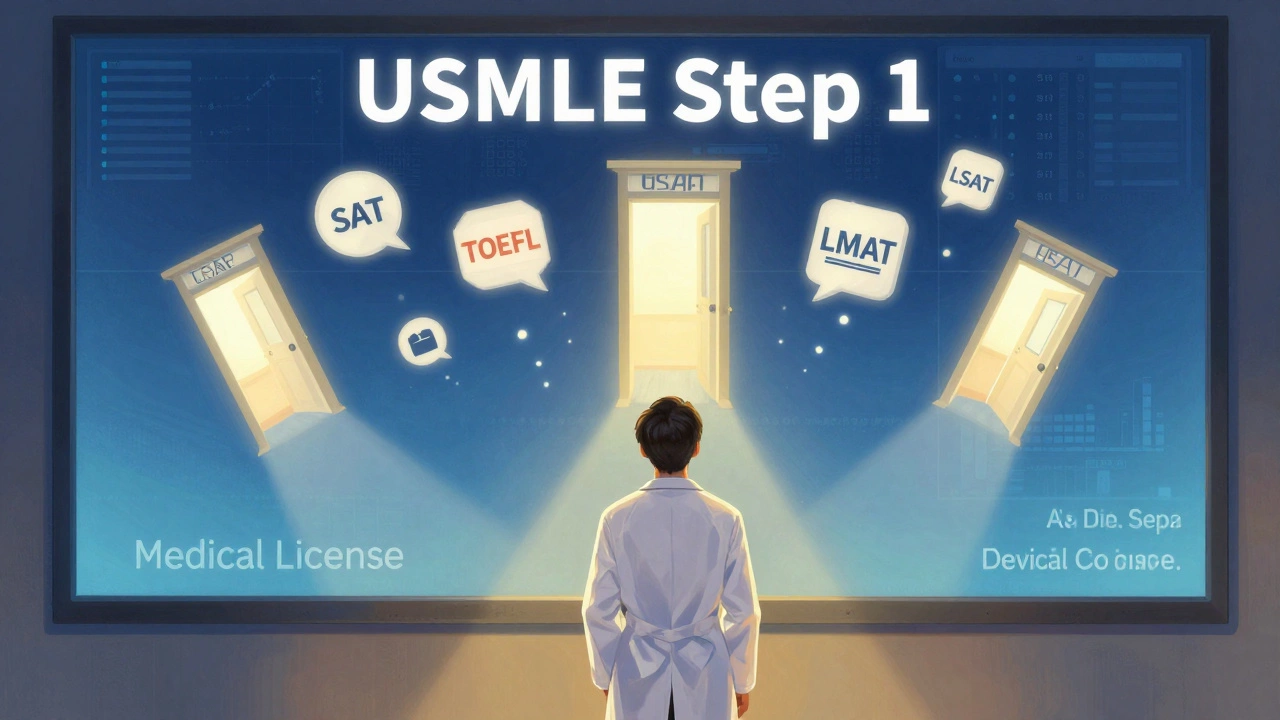
If you want to be a doctor, you’ll take the USMLE (United States Medical Licensing Examination). It’s a three-step process: Step 1 tests basic sciences, Step 2 covers clinical knowledge and skills, and Step 3 assesses your ability to practice independently. Passing all three is mandatory to get a medical license in the U.S.
For nurses, the NCLEX-RN is the national exam. It’s computer-adaptive, meaning the difficulty changes based on your answers. You must pass it to become a registered nurse. The pass rate for U.S.-educated candidates is around 85%, but international graduates often need more prep.
Engineers take the FE (Fundamentals of Engineering) and later the PE (Principles and Practice of Engineering). The FE is usually taken right after graduation. The PE comes after gaining four years of experience. Each engineering discipline-civil, mechanical, electrical-has its own PE exam.

What About International Students?
If you’re coming from outside the U.S., you’ll likely need to prove English proficiency. The TOEFL and IELTS are the two main tests. Most universities accept both, but some prefer TOEFL because it’s fully computer-based and mimics academic environments. IELTS has a paper-based option and includes a face-to-face speaking test.
TOEFL scores range from 0 to 120. Top schools usually require 100+. IELTS uses a 9-band scale. Most universities want 7.0 or higher. Some schools waive these requirements if you’ve studied in English for at least three years.
How to Choose the Right Exam
Don’t just pick the most popular one. Match the exam to your goal.
- Applying to undergrad? Focus on SAT or ACT.
- Going for an MBA? GMAT is your path.
- Want to study law? LSAT is non-negotiable.
- Planning a Ph.D. in science or humanities? GRE is likely required.
- Working in healthcare or engineering? Look up your field’s licensing exam early.
Check the official website of every program you’re interested in. Requirements change every year. Some schools dropped the GRE in 2023. Others now accept the GRE General Test plus a subject-specific test.
Preparation Tips That Actually Work
Most students waste months studying the wrong way. Here’s what works:
- Take a full-length practice test before you start studying. It shows your baseline and where you need help.
- Use official materials only. ETS (GRE, TOEFL), College Board (SAT), and ACT.org provide the most accurate practice questions.
- For timed tests like the LSAT or GMAT, practice under real conditions. Sit at a desk, no phone, 3-hour blocks.
- Focus on your weakest section, not your strongest. Improving from 150 to 160 on the LSAT is harder than going from 170 to 175.
- Don’t cram. Spread out prep over 3-6 months. Consistency beats last-minute stress.
Many students use free resources like Khan Academy for SAT prep or Magoosh for GRE. But don’t skip the official practice tests-they’re the only ones that match the real exam’s pattern and trick questions.
What Happens If You Fail?
You can’t technically "fail" these exams. They’re scored on a scale. But if your score is below the program’s average, your chances drop.
Most tests let you retake them. The SAT and ACT can be taken up to 12 times. GRE allows five times per year, with a 21-day gap between attempts. LSAT lets you take it three times in a single testing year (June to May). Some schools super-score (take your highest section scores from different sittings). Others only look at your latest attempt.
Don’t retake just to try again. If your score didn’t improve after 4-6 weeks of focused prep, something’s wrong with your strategy. Get help from a tutor or a structured course.
Final Thoughts
Competitive exams in the U.S. aren’t about memorizing facts. They’re about showing you can think under pressure, analyze quickly, and manage time. The right score doesn’t guarantee admission, but the wrong one can shut doors you didn’t even know were closed.
Start early. Know your goal. Use official materials. And remember-these tests measure preparation, not intelligence. With the right plan, anyone can improve.
Are SAT and ACT required for college in the USA in 2026?
Many U.S. colleges are still test-optional, meaning you don’t have to submit SAT or ACT scores. But top schools like MIT, Caltech, and Georgetown still recommend them. A strong score can boost your application, especially for scholarships or competitive majors. Always check each school’s admissions page for their current policy.
Which is easier, the GRE or the GMAT?
It depends on your strengths. The GRE has a broader range of math topics but less complex questions. The GMAT has harder math, especially in data sufficiency and integrated reasoning, but it’s more focused on business logic. If you’re strong in verbal and weak in math, GRE might be easier. If you’re good with data and analysis, GMAT could feel more natural. Most MBA applicants take the GMAT because it’s the standard.
Can I take the LSAT without a bachelor’s degree?
Yes, you can take the LSAT before finishing your bachelor’s. But you must have your degree before you enroll in law school. Most students take the LSAT in their junior year of college. Law schools require proof of graduation before you start your first semester.
Do I need to take TOEFL if I’m from India?
Most U.S. universities require TOEFL or IELTS from international students, including those from India. But if you completed your high school or undergraduate education entirely in English (e.g., CBSE English-medium schools), some schools may waive it. Always confirm with the admissions office. Some universities now accept Duolingo English Test as a cheaper, faster alternative.
How much do these exams cost?
SAT costs $60 (without essay, which is gone anyway). ACT is $68. GRE is $220. GMAT is $275. LSAT is $238. TOEFL is $210. IELTS is $240. These prices are as of 2026. Fee waivers are available for low-income students in the U.S. and some international students through the test providers.
Which exam is the hardest to pass?
There’s no single answer. The LSAT is known for its tricky logic games and tight timing. The USMLE Step 1 is notoriously difficult because it covers years of medical knowledge in one test. The GMAT’s integrated reasoning section trips up many because it combines math, verbal, and data analysis. But difficulty depends on your background. For someone with a science degree, the GRE might feel easy. For a literature major, the GMAT’s quant section could be a nightmare.
Knowing which exam to take-and when-is the first step toward success. Don’t wait until the last minute. Plan ahead, prepare smart, and take control of your future.