
Education System Fit Analyzer
USA Model
Holistic, creative freedom, discussion-based.
India Model
Structured, rigorous, foundational mastery.
Continuous
Projects, participation, constant feedback.
High-Stakes
Annual boards, competitive entrance exams.
Innovation/Management
Startups, leadership, interdisciplinary roles.
Technical Specialist
Engineering, medicine, deep technical expertise.
Investment First
Willing to pay high tuition for networking/prestige.
Affordability
Value public institutions and low-cost quality.
Your Recommended Path
Why this fits you:
Key Characteristics:
Imagine two students. One is in a classroom in New York, debating the ethical implications of AI with their peers. The other is in a classroom in Delhi, memorizing complex formulas for an upcoming board exam. Both are bright, hardworking, and ambitious. But their paths to success look completely different. For years, parents and students have asked the same question: Is the education system in the USA better than India’s? The answer isn’t a simple yes or no. It depends entirely on what you value more: creative freedom or structured discipline.
The Core Philosophy: Holistic Growth vs. Academic Rigor
To understand the difference, we first need to look at what each system is trying to achieve. The American model, particularly in higher education, focuses on holistic development. Schools want to produce well-rounded individuals who can think critically, speak publicly, and work in teams. You will see this in college applications where extracurricular activities, leadership roles, and personal essays matter just as much as grades.
In contrast, the Indian system, especially under the CBSE syllabus which is the Central Board of Secondary Education curriculum followed by most schools in India, prioritizes academic rigor and foundational knowledge. The goal is to build a strong base in core subjects like mathematics, science, and languages. This approach prepares students for high-stakes competitive exams that determine their future careers. While critics call it rote-learning heavy, proponents argue it builds mental stamina and deep subject mastery.
| Feature | USA Education System | Indian Education System (CBSE) |
|---|---|---|
| Focus Area | Holistic development, critical thinking | Academic excellence, technical skills |
| Assessment Style | Continuous evaluation, projects, participation | High-stakes annual board exams |
| Curriculum Flexibility | High; students choose electives early | Low; fixed streams (Science, Commerce, Arts) |
| Cost | Very High ($30k-$60k/year for private colleges) | Moderate to Low (Public institutions are affordable) |
| Entry Barrier | Admissions based on GPA, SATs, essays, extracurriculars | Entrance exams (JEE, NEET) dominate admissions |
Schooling Years: Structure and Pressure
In the United States, K-12 education is largely decentralized. Each state sets its own standards, but there is a general trend toward flexibility. Students take a wide range of classes, including physical education, arts, and social studies, alongside core academics. Homework exists, but the pressure cooker environment is less intense until the final year of high school. Teachers often encourage questioning and debate in class.
In India, the schooling experience is more uniform due to boards like CBSE, ICSE, and state boards. The CBSE syllabus is designed to be comprehensive and standardized across the country. From a young age, students are tracked into streams-Science, Commerce, or Humanities-after Class 10. This early specialization means a student interested in biology cannot easily switch to engineering later without significant hurdles. The pressure peaks during Class 12 board exams, which serve as a major gatekeeper for university admission.

Higher Education: Choice vs. Competition
This is where the divergence becomes stark. In the US, you apply to universities with a general intent. You might declare a major later, or even change it multiple times. A student can start in psychology and end up in computer science. This flexibility encourages exploration. However, this freedom comes with a massive price tag. Tuition fees at top-tier private universities can exceed $80,000 per year, leading many graduates to carry significant debt.
In India, you must know exactly what you want before you enter college. If you want to be an engineer, you prepare for the JEE (Joint Entrance Examination). If you want to be a doctor, you prepare for NEET. These exams are notoriously difficult, with millions competing for a few thousand seats in premier institutes like the IITs and AIIMS. Once admitted, the curriculum is fixed. There is little room to wander. On the flip side, public universities in India offer world-class education at a fraction of the cost. An engineering degree from an IIT costs significantly less than a community college degree in the US, making it highly accessible for middle-class families.
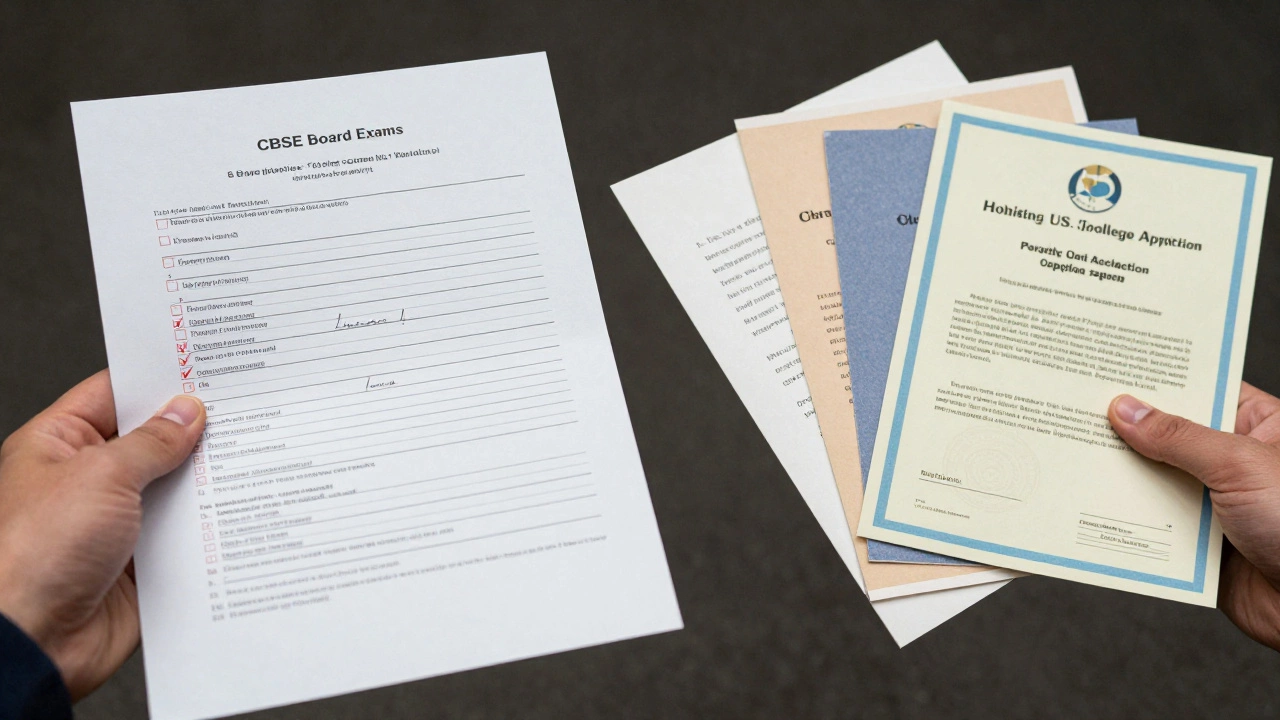
The Impact on Career Readiness
Which system produces better employees? It depends on the industry. US graduates are often praised for their soft skills, adaptability, and ability to innovate. They are trained to solve open-ended problems. This makes them valuable in creative industries, startups, and management roles. However, they sometimes lack the deep technical grounding seen in their Indian counterparts.
Indian graduates, shaped by the rigorous demands of the CBSE syllabus and subsequent competitive exams, are known for their strong analytical abilities and work ethic. They excel in fields requiring precision and technical depth, such as software engineering, data analysis, and medicine. Multinational companies often prefer Indian engineers for backend development and technical support roles because of this robust foundation. However, Indian students sometimes struggle with communication skills and independent decision-making, areas where the US system excels.

Is One Truly "Better"?
Labeling one system as superior ignores the context. The US system is better if you value creativity, interdisciplinary learning, and have the financial resources to support it. It fosters innovation and leadership. The Indian system is better if you seek affordability, structured learning, and aim for careers in technical or professional fields where standardized knowledge is key. It provides a clear, meritocratic path based on exam performance.
Moreover, the gap is narrowing. India’s National Education Policy (NEP) 2020 aims to introduce more flexibility, reduce rote learning, and promote multidisciplinary education, borrowing ideas from Western models. Meanwhile, US schools are increasingly focusing on STEM (Science, Technology, Engineering, Mathematics) to compete globally. Both systems are evolving to meet the needs of a modern workforce.
What Should You Choose?
If you are a student deciding between staying in India or studying abroad, consider your personality and goals. Do you thrive under pressure and enjoy mastering specific subjects? The Indian path might suit you. Do you prefer exploring various interests and value campus life and networking? The US might be more appealing. Remember, neither system guarantees success. Your individual effort, curiosity, and resilience matter far more than the label on your diploma.
Is the US education system easier than India's?
Not necessarily easier, but different. The US system emphasizes continuous assessment, participation, and projects, which can feel less stressful than India's high-stakes annual exams. However, the workload in US universities, especially in top programs, is extremely heavy with constant reading, writing, and presentations. India's system is intense during exam periods but may have lighter daily homework loads compared to the constant output required in the US.
Can I use my CBSE marks to apply to US universities?
Yes, US universities accept CBSE Class 12 marks as part of your application. However, they also typically require standardized test scores like the SAT or ACT, English proficiency tests (TOEFL/IELTS), and a strong portfolio of extracurricular activities. Your CBSE grades are important, but they are just one component of a holistic review process.
Which system is better for engineering jobs?
For core engineering roles (civil, mechanical, electrical), the Indian system, particularly from IITs and NITs, provides a very strong theoretical foundation. For software and tech roles, both systems produce excellent candidates. US graduates may have an edge in product design and user experience due to broader exposure, while Indian graduates often excel in coding efficiency and backend architecture. Many Indian engineers eventually move to the US for higher salaries and diverse opportunities.
Is the cost of education in the USA worth it?
It depends on the career outcome. Top US universities offer global recognition, extensive alumni networks, and access to high-paying internships and jobs. If you graduate from a prestigious US institution and secure a high-salary job, the return on investment can be positive despite the debt. However, for average universities, the high tuition fees may not justify the outcome, especially when compared to affordable, high-quality options in India.
How does the new NEP 2020 change the Indian education system?
The National Education Policy 2020 aims to make the Indian system more flexible and holistic. It introduces multidisciplinary learning, allowing students to mix subjects like arts and science. It reduces the importance of single-board exams by promoting continuous assessment. While implementation is still ongoing, the goal is to bridge the gap between the rigid Indian structure and the flexible Western model.