
JEE Strategy Planner: Mains vs. Advanced
Determine if your current study approach is better suited for JEE Mains (Breadth/Speed) or JEE Advanced (Depth/Analysis). Answer the following based on your last 2 weeks of prep.
Your Profile: -
0% MatchThe High-Stakes Bridge to Engineering
Imagine spending two years staring at HC Verma and Irodov, only to realize you're preparing for two completely different games. That is exactly how it feels when you first encounter the duo of JEE Mains and JEE Advanced. It isn't just a matter of one being 'harder' than the other; they test different parts of your brain. One asks if you know the formula and can apply it quickly; the other asks if you truly understand why that formula exists in the first place.
If you are aiming for a seat in India's top engineering colleges, you can't treat these as a single exam. You have to navigate a two-stage filter. The first stage clears the crowd, and the second stage separates the conceptual masters from the rote learners. Let's break down exactly how these two beasts differ so you can plan your study schedule without burning out.
Quick Summary for Aspirants
- JEE Mains: The qualifying gateway. Focuses on speed, accuracy, and a wide breadth of syllabus.
- JEE Advanced: The final hurdle. Focuses on deep conceptual depth, multi-concept problems, and analytical thinking.
- Eligibility: You must score high enough in Mains to even sit for Advanced.
- Outcome: Mains gets you into NITs and IIITs; Advanced is the only way into the IITs.
The Core Purpose: Gateway vs. Final Selection
To understand the difference, we first need to look at the JEE Mains is a national-level entrance exam conducted by the National Testing Agency (NTA) to provide a common entrance for various engineering colleges in India. It serves as the primary screening test. If you want to get into NITs (National Institutes of Technology) or IIITs (Indian Institutes of Information Technology), your Mains score is the final word.
On the other hand, JEE Advanced is the rigorous second-stage exam conducted by one of the seven IITs on a rotational basis to select candidates for admission to the Indian Institutes of Technology. You cannot simply register for Advanced; you have to earn your ticket by being among the top 2.5 lakh candidates in the Mains session. While Mains is about qualifying, Advanced is about ranking. In Advanced, the goal isn't just to pass, but to secure a rank high enough to land a coveted branch like Computer Science at IIT Bombay.
Comparing the Exam Patterns
The way these exams are structured tells you everything about what the examiners want. JEE Mains is a standardized, computer-based test. It follows a predictable pattern: a mix of Multiple Choice Questions (MCQs) and Numerical Value Questions. The clock is your biggest enemy here. You have to solve a large number of questions in a short window, meaning you need an instinctive grasp of the basics.
JEE Advanced is a different animal. The pattern changes almost every year. One year you might have multiple-correct options, and the next, you might see matching lists or integer-type questions with no options provided. The marking scheme is often treacherous, with negative marking that can tank your score if you guess blindly. While Mains asks "What is the value of X?", Advanced asks "Given these three unrelated physics laws and a complex geometric shape, how does X change over time?"
| Feature | JEE Mains | JEE Advanced |
|---|---|---|
| Conducting Body | NTA | Rotational IITs |
| Primary Goal | Qualifying & NIT Admission | IIT Admission |
| Question Type | Direct, Formula-based | Analytical, Multi-concept |
| Frequency | Twice a year | Once a year |
| Difficulty Level | Moderate | Very High |
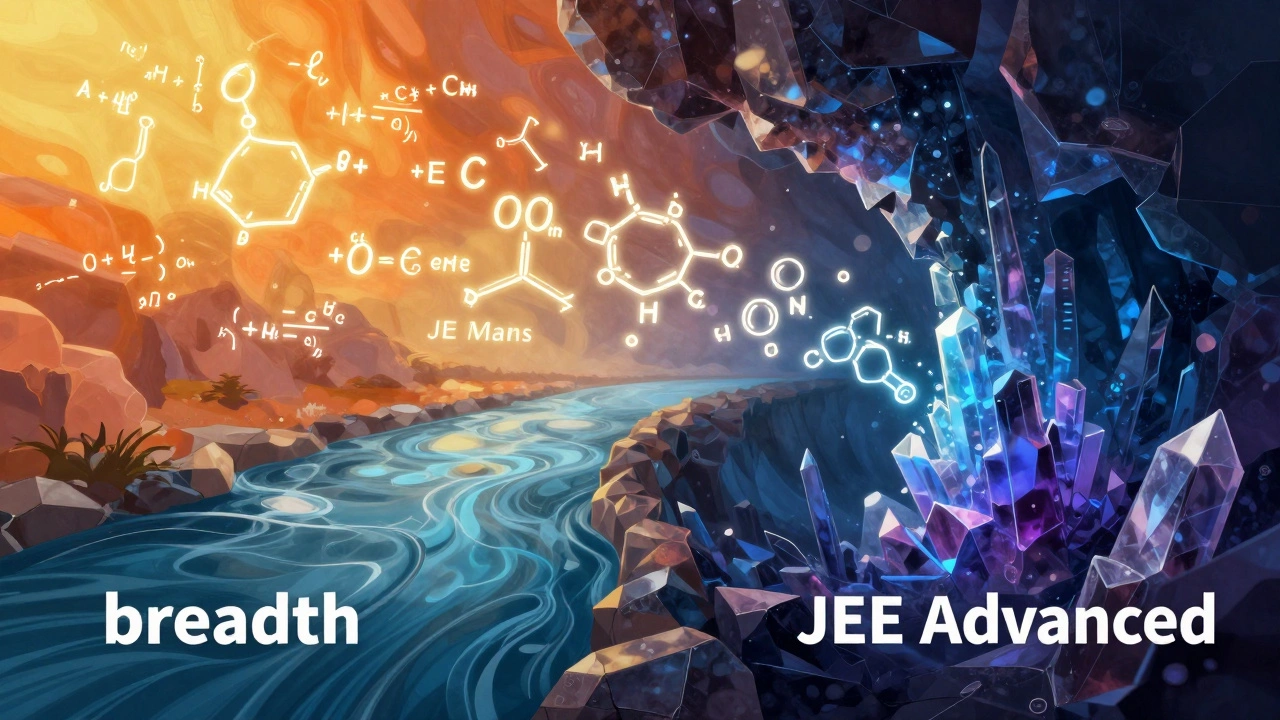
The Syllabus Trap: Breadth vs. Depth
Here is where most students trip up. If you look at the official syllabus for Physics, Chemistry, and Mathematics, they look almost identical for both exams. But the application of that syllabus is where they diverge.
In JEE Mains, you might be asked to solve a problem using a single formula from a specific chapter. For example, a question on Thermodynamics might just require you to calculate work done using a standard equation. It's a test of your memory and speed. You can score very high by practicing thousands of similar problems until they become muscle memory.
JEE Advanced doesn't care if you've memorized the formula. It wants to see if you can derive it or apply it in a scenario you've never seen before. An Advanced problem on Thermodynamics might combine concepts from Electrostatics and Fluid Mechanics in a single question. You can't "pattern match" your way through Advanced; you have to think your way through it. This is why students who score 99 percentile in Mains sometimes struggle to even qualify for Advanced-they were great at solving, but not great at analyzing.
Strategic Approach for Each Stage
Since the goals are different, your study habits must evolve. For the Mains phase, your focus should be on coverage. You cannot afford to skip any chapter because a simple question from a "boring" topic could be the difference between qualifying and failing. Use a timer, solve previous year papers, and focus on reducing your silly mistakes. Accuracy is king here.
Once you clear the Mains cutoff, shift your gear toward depth. Stop focusing on the number of questions solved and start focusing on the quality of the problems. Instead of solving 50 easy questions, spend three hours wrestling with five extremely difficult problems. Learn to embrace the frustration of not knowing the answer immediately. This mental endurance is what allows a student to stay calm during the six hours of the Advanced exam.

Common Pitfalls to Avoid
A huge mistake many students make is ignoring Chemistry in the pursuit of Physics and Math. In both exams, Chemistry-especially Organic Chemistry-is often the scoring engine. In Mains, it's a race against time, and Chemistry is the fastest section to complete. In Advanced, conceptual clarity in Inorganic Chemistry can save you from the brutal difficulty of the Math paper.
Another pitfall is "Mains-style thinking" during the Advanced exam. If you find yourself trying to plug numbers into a formula and it's not working after two minutes, stop. In Advanced, that usually means you've missed a conceptual constraint or a trick in the question. Re-read the problem. Look for the hidden link between the given variables. The answer in Advanced is rarely on the surface; it's buried under layers of logic.
Can I get into an IIT through JEE Mains?
No. JEE Mains only serves as a qualifying exam for the IITs. To get admission into any Indian Institute of Technology (IIT), you must appear for and qualify in JEE Advanced. However, you can get into NITs, IIITs, and other GFTIs using your JEE Mains rank.
Is the syllabus different for both exams?
The core topics in Physics, Chemistry, and Mathematics are largely the same. However, the level of depth and the way the questions are framed differ significantly. Mains focuses on direct application and speed, while Advanced focuses on complex, multi-conceptual problems and deep analytical thinking.
What happens if I qualify for JEE Advanced but get a low rank?
If your rank is too low for a preferred IIT or branch, you can still use your JEE Mains rank to apply for NITs or IIITs during the JoSAA (Joint Seat Allocation Authority) counseling process. This is why it is crucial to perform well in both exams.
How many attempts do I get for JEE Mains and Advanced?
JEE Mains is typically conducted twice a year within a single academic session. For JEE Advanced, you can generally attempt the exam for two consecutive years starting from the year you pass your 12th grade. It is important to check the latest NTA and JAB guidelines for the current year.
Which exam is harder?
JEE Advanced is universally considered much harder. While Mains tests your basic competence and speed, Advanced tests your intellectual limit and ability to apply concepts to unfamiliar problems. The failure rate is significantly higher in Advanced due to its conceptual rigor.
Next Steps for Your Journey
If you are just starting your prep, don't obsess over Advanced yet. Master the NCERTs and solve a healthy amount of Mains-level problems to build your confidence and a strong foundation. Once you are consistently scoring well in mock Mains tests, start introducing "Challenge Problems" from Advanced archives.
For those already in the thick of it, start diversifying your question banks. If you've mastered the standard MCQs, move to subjective-style problems where you have to derive the answer. This shift in mindset-from "finding the right option" to "building the right solution"-is the secret to conquering the IIT JEE journey.