
Education Path Finder: India vs USA
Not sure which system fits your future? Answer three key questions to get a personalized recommendation.
Core Engineering / Medicine
Focus on deep technical skills, high volume practice, and rigorous theoretical foundations.
Leadership / Innovation
Focus on soft skills, networking, entrepreneurship, and creative problem-solving.
Hybrid / Undecided
Want strong basics but also exposure to flexible thinking and global standards.
Low Budget (<$5k/yr)
Prefer subsidized public institutions or cost-effective degrees.
High Budget ($30k+/yr)
Can afford private tuition fees or are seeking scholarship opportunities in the US.
Moderate / Strategic
Open to spending later (e.g., Master's in US after Bachelor's in India).
Structured & Clear
Thrive with rigid syllabi, clear benchmarks, and exam-focused preparation.
Flexible & Creative
Prefer electives, debates, projects, and holistic assessment over rote memorization.
Adaptable
Comfortable switching modes or combining discipline with autonomy.
Your Recommended Path
Why this fits you:
Key Considerations:
Picture this: Two students. One is grinding through a CBSE syllabus curriculum in Chennai, memorizing dates and formulas to crack the JEE. The other is in Ohio, debating philosophy and coding a robot for a science fair. Who gets the better education? It’s not about who knows more facts. It’s about what you want your brain to do with them.
This isn't a simple "winner takes all" debate. Comparing education in India vs USA systems is like comparing a sprint to a marathon. They train different muscles. If you’re an Indian student eyeing foreign universities, or a parent confused by conflicting advice, you need clarity, not clichés. Let’s break down exactly how these two systems differ, where each shines, and which path actually serves your future career best.
The Foundation: Rote Learning vs Critical Thinking
The biggest difference starts at the root. In India, especially under boards like CBSE (Central Board of Secondary Education), the focus has historically been on mastering content. You learn the theorem, then you apply it to ten variations of the same problem. This builds incredible depth and discipline. If you can solve complex integrals from memory, you have a strong analytical foundation.
In the US, the K-12 system (Kindergarten through 12th grade) leans heavily into breadth and application. Students are encouraged to question why a theorem works before they memorize it. Classrooms often look chaotic to an outsider-debates, group projects, and open-ended questions are standard. The goal isn’t just to get the right answer; it’s to defend your reasoning. For many Indian students moving to the US, this shift is jarring. Suddenly, knowing the formula isn’t enough; you have to explain its real-world implication.
Curriculum Structure: Rigidity vs Flexibility
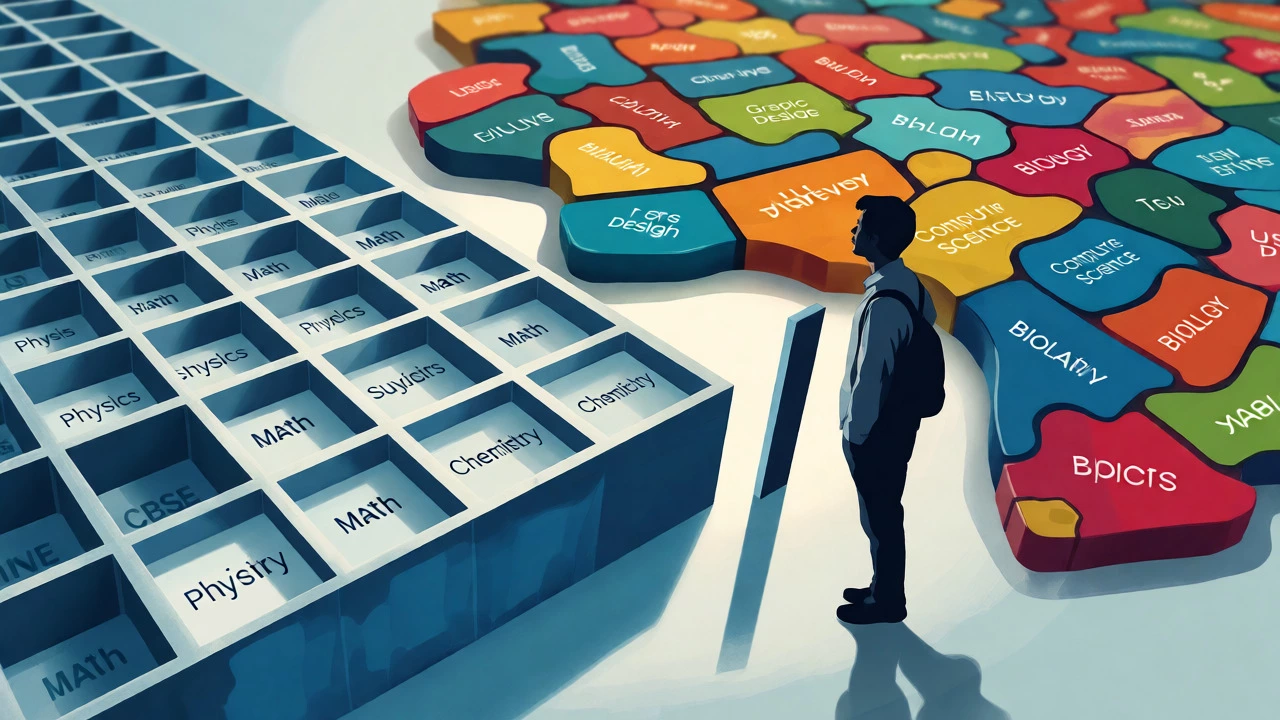
If you look at the CBSE syllabus for classes 9 to 12, it is highly structured. Science students take Physics, Chemistry, Math, and English. Commerce students take Accountancy and Economics. There is very little room to deviate. If you love coding but hate History, too bad-you still have to pass History to move up.
The US system flips this script. High school students build their own schedules. A future engineer might skip advanced biology to take AP Computer Science and Graphic Design. This flexibility allows students to explore interests early. However, it requires self-discipline. Without a rigid structure, some students drift. The risk in India is burnout from overload; the risk in the US is lack of foundational rigor in certain areas if not chosen wisely.
Assessment Methods: Exams vs Holistic Review
How you are judged shapes how you learn. In India, the board exams and entrance tests like JEE or NEET are make-or-break moments. One paper determines your college fate. This creates immense pressure but also clear benchmarks. If you score 95%, you know exactly where you stand relative to peers nationwide.
US admissions are holistic. Grades matter, yes, but so do extracurriculars, essays, letters of recommendation, and leadership roles. A student with straight As but no outside activities might lose to a student with B+ grades who started a community initiative. This system rewards well-roundedness but introduces subjectivity. An essay that resonates with one admission officer might be ignored by another. For Indian parents used to objective scoring, this ambiguity can feel unfair.
Higher Education: Cost and Quality Trade-offs
Let’s talk money. Higher education in India is subsidized. A degree from an IIT or AIIMS costs a fraction of what similar programs cost in the US. The quality of technical education in top Indian institutes is world-class, particularly in engineering and medicine. Faculty-to-student ratios can be high, but the peer group is fiercely competitive, pushing everyone to perform.
In the US, tuition fees are staggering. A four-year private university degree can exceed $200,000. But you pay for access to vast libraries, cutting-edge labs, and a network that spans global industries. US universities also offer financial aid based on need, which can level the playing field for international students, though competition for scholarships is intense. The ROI depends entirely on the institution. A generic state college diploma in the US may not hold the same weight as a top-tier IIT degree in the tech job market back home.
| Feature | India (CBSE/Top Institutes) | USA (K-12 & Top Universities) |
|---|---|---|
| Core Focus | Conceptual depth, theoretical mastery, exam performance | Critical thinking, creativity, practical application |
| Curriculum Style | Rigid, standardized, subject-specific streams | Flexible, elective-based, interdisciplinary |
| Assessment | High-stakes written exams (JEE, NEET, Boards) | GPA, SAT/ACT, Essays, Extracurriculars |
| Cost of Degree | Low to Moderate ($1k - $5k/year public) | Very High ($30k - $60k+/year private) |
| Class Size | Larger lectures, limited interaction | Smaller seminars, high faculty interaction |
| Research Opportunities | Available but concentrated in top tiers | Widespread, integrated into undergrad studies |
Where Each System Excels
Don’t dismiss either system. The Indian model produces resilient, technically proficient graduates. Engineers from India are globally respected because they’ve survived a filter that weeds out the uncommitted. The rigorous math and science training provides a head start in fields requiring heavy computational skills. If you thrive in structured environments and prefer clear metrics for success, the Indian system offers a reliable ladder.
The US model excels in innovation and soft skills. Graduates are often better at public speaking, networking, and navigating ambiguous problems. The emphasis on teamwork and presentation prepares students for corporate cultures that value collaboration over solitary genius. If you aim for leadership roles, entrepreneurship, or creative industries, the US environment fosters those traits more naturally.

The Hybrid Reality: What Most Students Actually Do
Here is the secret nobody tells you: most successful students mix both. Many Indian families keep children in the CBSE syllabus framework during schooling to ensure strong basics, then switch to IB or American curricula in high school to prepare for US colleges. Why? Because it gives them the best of both worlds. They retain the mathematical rigor while learning to write essays and think critically.
At the university level, the trend is shifting too. Indian institutes are introducing more project-based learning. US universities are recognizing the value of specialized technical depth. The lines are blurring. If you are planning to study abroad, don’t view your current schooling as a handicap. Use the discipline you gained in India as your engine, and use the exposure to US-style critical thinking as your steering wheel.
Making the Choice: A Decision Framework
So, is education better in India or the USA? Ask yourself these three questions:
- What is your career goal? If you want to become a surgeon or a core mechanical engineer, Indian institutions provide unparalleled volume and variety of cases/exposure at a low cost. If you want to work in product management, marketing, or software development in global firms, US degrees offer better networking and brand recognition.
- What is your financial capacity? Can you afford $200k debt? If not, a top Indian institute plus a master’s in the US later is a smarter financial play than an average US undergraduate degree.
- How do you learn best? Do you need strict deadlines and clear answers? Stick with the Indian structure. Do you get bored without autonomy and debate? Look toward US-style education.
There is no universal "better." There is only "better for you." The education system is a tool, not a destiny. Choose the tool that sharpens your specific skills for the job you want.
Is the CBSE syllabus harder than the US high school curriculum?
Generally, yes, in terms of content depth and pace. The CBSE syllabus covers topics in greater detail and at a younger age compared to standard US high schools. However, US Advanced Placement (AP) courses can match or exceed CBSE difficulty in specific subjects. The difference lies in assessment: CBSE tests recall and application, while US assessments often test analysis and synthesis.
Do US universities accept Indian board marks directly?
Yes, but with caveats. Most US universities require equivalent GPA calculations. A percentage in CBSE/ISC is converted to a 4.0 scale. Additionally, students usually need to submit SAT or ACT scores, along with TOEFL or IELTS for language proficiency, to validate their academic standing against US standards.
Which country has better job opportunities for graduates?
It depends on the industry. The US offers higher salaries and a larger tech/job market, especially in Silicon Valley and major hubs. However, visa restrictions (like H-1B caps) can limit long-term stay. India offers rapid career growth in IT and services, with less bureaucratic friction for local graduates. Global companies increasingly hire from both markets based on skill, not just location.
Is studying in the USA worth the cost for Indian students?
For top-tier universities (Ivy League, Stanford, MIT), yes-the brand value and network justify the cost. For mid-tier state universities, the ROI is lower unless you secure scholarships or work part-time during studies. Many students opt for a bachelor's in India followed by a master's in the US to balance cost and credential value.
Can I switch from CBSE to American curriculum midway?
Yes, many international schools in India offer this transition. Moving to an American curriculum (like AP or Common Core aligned) in grades 9-10 is common for families planning US higher education. It helps students adapt to writing-intensive assignments and continuous assessment models before applying to colleges.