Government Job Career Path Finder
Not sure where to start? Answer these questions to find your primary exam track and get a personalized preparation strategy.
Most people think getting a government job is just about memorizing facts and passing a test. That’s the biggest myth out there. The reality? It’s a marathon of strategic planning, strict eligibility checks, and understanding the bureaucratic machinery before you even pick up a textbook. If you’re staring at a pile of notification PDFs wondering where to begin, you aren’t alone. Thousands of graduates hit this wall every year. The good news is that breaking into the public sector isn’t reserved for geniuses or those with political connections. It requires a clear roadmap.
This guide cuts through the noise. We aren’t here to recite dry rules. We’ll walk you through exactly how to identify your target role, navigate the complex application landscape, and build a study routine that actually sticks. Whether you are eyeing administrative roles in the Union Public Service Commission (UPSC), technical posts in railway services, or state-level clerical positions, the foundational steps remain remarkably similar.
Identify Your Target Role and Eligibility
Before you buy a single book, you need to know what you’re aiming for. "Government work" is too broad. Are you looking for stability, prestige, power, or a specific salary bracket? Each category demands different preparations.
Start by filtering opportunities based on three hard constraints: education, age, and domicile requirements. For instance, if you hold a B.Tech degree, you might be eligible for engineering posts in organizations like Public Sector Undertakings (PSUs) via GATE scores, but ineligible for general clerk roles in some states that require a BA. Conversely, law graduates have a distinct advantage in judicial service exams.
- Educational Qualification: Does the post require a specific degree (e.g., CA, Law, Engineering) or any graduate degree?
- Age Limits: Check the upper age limit carefully. General categories often have stricter caps compared to reserved categories.
- Nationality & Domicile: Some state PSCs require you to be a resident of that state for a certain number of years.
A common mistake is applying for everything. This dilutes your focus. Pick one primary track-say, Civil Services-and one backup track, such as Banking (IBPS). Trying to prepare for both simultaneously without overlapping syllabi leads to burnout.
Decode the Exam Structure
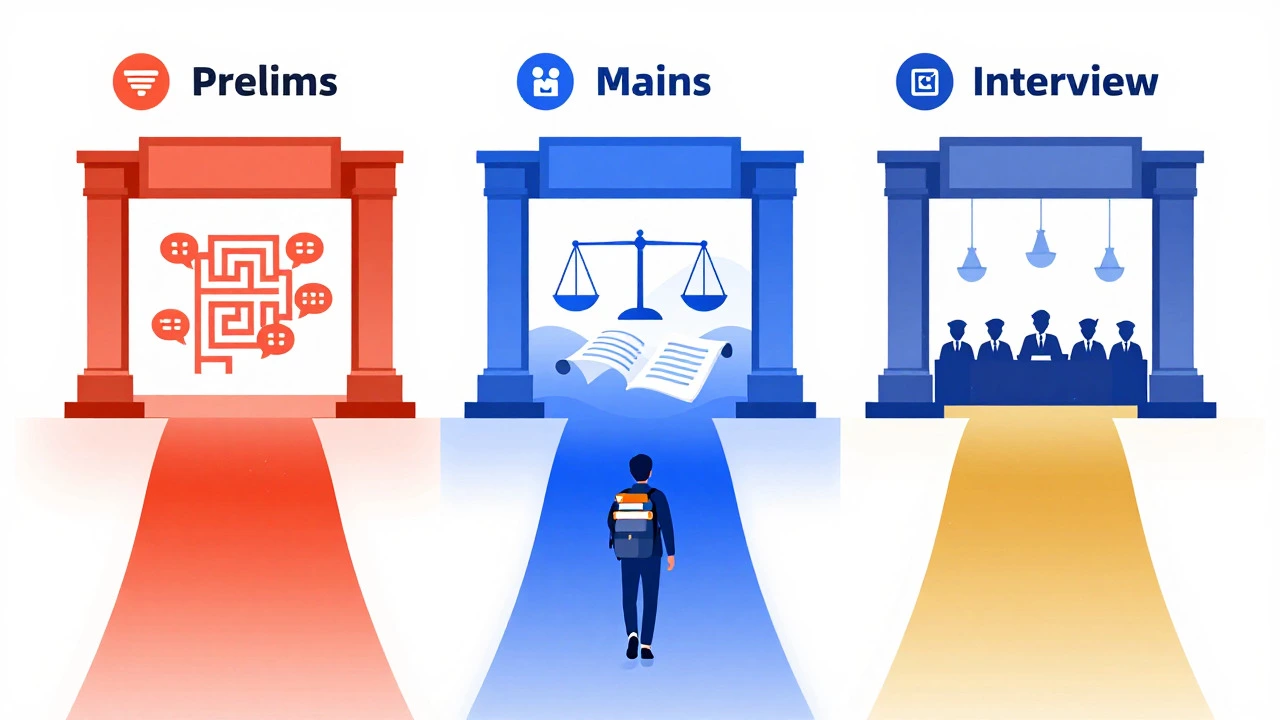
Once you’ve picked your lane, dissect the selection process. Most government exams follow a multi-stage pattern: Preliminary (objective), Main (descriptive/technical), and Interview/Viva Voce. Understanding this structure dictates how you study.
For example, the Civil Services Examination (CSE) conducted by UPSC has three stages. The Prelims test your factual recall and logical reasoning under time pressure. The Mains test your ability to articulate arguments in written form. The Interview tests your personality and situational judgment. Preparing only for MCQs will fail you in the Mains. Ignoring current affairs will fail you in all three.
| Exam Type | Primary Focus | Selection Stages | Preparation Time (Avg) |
|---|---|---|---|
| Civil Services (UPSC) | General Studies, Optional Subject, Essay | Prelims, Mains, Interview | 1-2 Years |
| Banking (IBPS/SBI) | Quantitative Aptitude, Reasoning, English | Prelims, Mains, Interview | 6-9 Months |
| SSC CGL | General Intelligence, GK, Quant, English | Tier I, Tier II, Interview | 8-12 Months |
| State PSCs | State-specific History, Geography, GK | Prelims, Mains, Interview | 1 Year+ |
Notice the difference in preparation time. Banking exams reward speed and accuracy in math and logic. Civil Services reward depth and analytical writing. Adjust your daily schedule accordingly.
Build a Realistic Study Plan
You don’t need to study 14 hours a day. You need consistency. A realistic plan accounts for your current lifestyle. Are you a full-time aspirant? Or are you working while preparing? Working professionals usually have 3-4 hours of quality study time per day. Full-time aspirants should aim for 6-8 focused hours.
Break your syllabus into micro-goals. Instead of saying "I will study History," say "I will cover the Mauryan Empire chapter today." Use the Pomodoro technique-25 minutes of intense focus followed by a 5-minute break-to maintain mental freshness. Review previous years’ question papers first. They reveal the examiner’s mindset better than any textbook introduction.
Integrate current affairs into your daily routine. Read a reputable newspaper like The Hindu or Indian Express. Don’t just read; make notes. Link news events to static syllabus topics. For example, if there’s news about water disputes, link it to your Geography section on river systems.
Master the Application Process
Getting rejected because of a technical error in your application is heartbreaking. Government portals can be unforgiving. Ensure your documents are scanned correctly, formatted as per specifications (often JPEG/PDF with specific size limits), and named properly.
Common pitfalls include mismatched names across certificates, incorrect caste certificate details, or missing photo signatures. Double-check every field. Keep a dedicated folder on your computer and cloud storage with all essential documents: birth certificate, mark sheets, caste/income certificates, and passport-sized photos. Update these regularly.
Pay attention to deadlines. Apply early to avoid server crashes during the final days. Also, keep an eye on correction windows. Many candidates miss the chance to fix errors because they assume the application is locked immediately after submission.

Develop Soft Skills and Interview Readiness
Clearing the written exam is half the battle. The interview panel assesses your communication skills, confidence, and awareness of social issues. Start practicing now. Join peer groups or mock interview sessions. Learn to articulate your opinions clearly and respectfully.
Be prepared to answer questions about why you want a government job. Avoid clichés like "service to the nation." Be honest. Maybe you value job security, work-life balance, or the opportunity to implement policy changes. Authentic answers resonate more with panels.
Also, cultivate a habit of reading non-fiction related to governance, economics, and sociology. This builds a reservoir of knowledge that helps you speak fluently during interviews. Stay updated on recent government schemes and policies. Knowing the name and purpose of major initiatives like Ayushman Bharat or PM-KISAN shows genuine interest.
Leverage Technology and Resources
The internet has democratized government job preparation. You no longer need expensive coaching classes if you’re disciplined. Use free resources wisely. YouTube channels offer excellent conceptual clarity for subjects like Polity and Economics. Apps provide daily quizzes and current affairs capsules.
However, beware of information overload. Stick to limited sources. One standard textbook per subject, one newspaper, and one monthly magazine are sufficient. Supplement with online test series for practice. Analyze your mistakes in mock tests rigorously. Understanding why you got a question wrong is more valuable than scoring high.
Join online communities on platforms like Telegram or Reddit. These groups share notifications, doubts, and motivation. But filter the noise. Ignore panic-inducing messages from others who haven’t cleared their own exams. Focus on your progress metrics.
Do I need a specific degree to get a government job?
It depends entirely on the post. Administrative roles like IAS or PCS generally require any bachelor's degree from a recognized university. Technical roles in engineering or medicine require specific degrees (B.E./B.Tech or MBBS). Always check the official notification for exact educational criteria.
Is coaching necessary for government job preparation?
No, coaching is not mandatory. Many successful candidates self-study using standard books and online resources. Coaching helps with structured guidance and doubt clearing, which benefits beginners or those lacking discipline. Assess your learning style before investing money.
What is the best age to start preparing?
Ideally, start during your final year of graduation. This gives you ample time to build concepts without the pressure of immediate employment. However, many people start after working for a few years. There is no 'too late' as long as you fall within the age limits specified in the notification.
How many attempts do I have for government exams?
Attempt limits vary by category and exam. For UPSC Civil Services, General Category candidates get 6 attempts until age 32, OBC gets 9 attempts until age 35, and SC/ST have unlimited attempts until age 37. Other exams may have different rules or no attempt limits, relying solely on age caps.
Can I apply for multiple government jobs at once?
Yes, you can apply for multiple jobs if you meet the eligibility criteria. However, ensure the exam dates do not clash. Also, consider whether the syllabi overlap enough to justify dual preparation. Applying for unrelated exams simultaneously can lead to scattered efforts.