
MBA Stress Level Estimator
How stressed are you during your MBA?
This tool estimates your stress risk based on current indicators. Remember: the article shows 68% of MBA students report chronic sleep deprivation and 52% feel overwhelmed weekly.
Your Stress Assessment
- Set non-negotiables for sleep, family time, or exercise
- Stop comparing yourself to others
- Use campus counseling resources
Everyone talks about the MBA like it’s a golden ticket - higher salary, better job, bigger title. But no one tells you how much it eats into your sleep, your relationships, and your sanity. If you’re thinking about applying, here’s the truth: an MBA is not just hard. It’s exhausting. And it’s not just because of the exams. It’s because of the constant performance pressure, the fear of falling behind, and the feeling that everyone around you is running faster than you.
The daily grind: 16-hour days aren’t rare
Most MBA students wake up before 6 a.m. to squeeze in a workout, review last night’s case, and check emails from group members who didn’t reply until midnight. By 8 a.m., you’re in class. By 1 p.m., you’re in a team meeting to finalize a presentation due at 5 p.m. By 7 p.m., you’re at a networking event with recruiters. By 11 p.m., you’re finally reading the 30-page case you were supposed to finish last week.At top schools like IIM Ahmedabad or ISB, students average 60-70 hours a week just on coursework and group projects. Add in job hunting, internships, and campus recruiting prep, and you’re looking at 80+ hour weeks during peak season. That’s not a rumor. That’s what the 2024 MBA Student Wellbeing Survey from the Graduate Management Admission Council found - 68% of students reported chronic sleep deprivation, and 52% said they felt overwhelmed every single week.
It’s not the classes - it’s the competition
You think the stress comes from difficult finance models or marketing frameworks? No. The real pressure comes from being surrounded by people who were valedictorians, startup founders, or consultants at McKinsey. Everyone has a story. Everyone seems to have it figured out. Meanwhile, you’re wondering if you made a mistake quitting your job to do this.Group projects turn into power struggles. One person does 80% of the work because they’re scared of getting a bad grade. Another person shows up late to every meeting because they’re interviewing with Google. You start measuring your worth by who got the internship, who got the promotion, who got the highest score on the midterm. Your self-worth becomes tied to a GPA that doesn’t even matter after graduation.
The recruiting cycle: a 6-month nightmare
If you’re aiming for consulting, finance, or tech, recruiting starts in August - yes, August - for jobs that begin in July next year. That means for nearly half your MBA, you’re not learning. You’re preparing.You spend weekends writing and rewriting your resume. You do mock interviews with career services. You attend 15 company info sessions. You cold-email alumni. You lose sleep over a case interview you bombed. And then you get rejected. Again. And again. And again.
At some schools, over 40% of students don’t land their dream job by graduation. The ones who do? They’re the ones who treated recruiting like a full-time job - and sacrificed their health, relationships, and mental peace to do it.
What no one tells you: the emotional toll
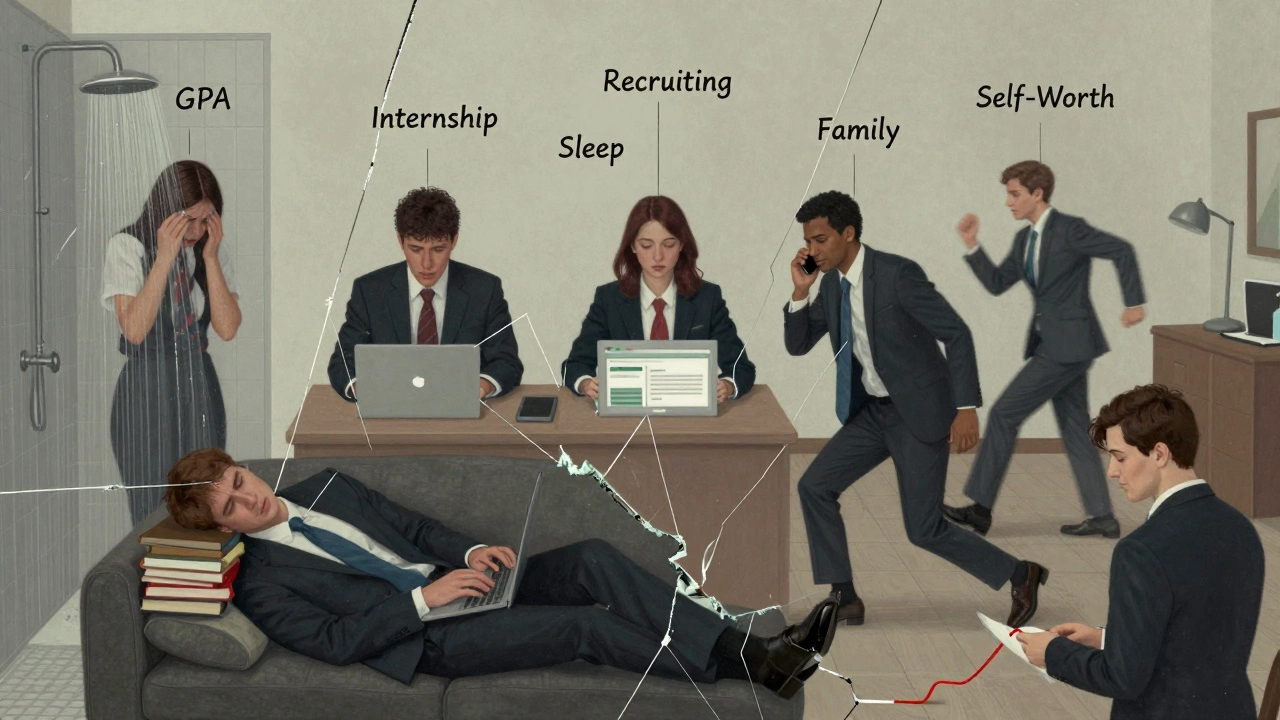
You’ll cry in the library. You’ll skip family calls because you’re too tired to talk. You’ll lie to your partner about how you’re doing because you don’t want to admit you’re drowning. You’ll watch your friends post about their promotions while you’re still stuck on a spreadsheet at 2 a.m.Depression and anxiety rates among MBA students are 2-3 times higher than the general population. A 2023 study from Harvard Business School found that 37% of MBA students met clinical criteria for moderate to severe anxiety. And yet, most schools still don’t have enough counselors. The stigma around mental health? It’s still alive. You’re told to ‘push through.’ To ‘be resilient.’ But resilience isn’t about ignoring pain. It’s about knowing when to ask for help.
Who handles it well? And who doesn’t?
Some people thrive. They’re the ones who set boundaries. They block off Sundays for family. They say no to extra projects. They go to the gym three times a week - not because they care about abs, but because it’s the only thing that makes them feel human again.Others burn out. They’re the ones who say yes to everything. Who think skipping sleep for one more case will make them stand out. Who compare themselves to others on LinkedIn. Who believe that if they’re not exhausted, they’re not trying hard enough.
The difference? Control. People who survive the MBA without breaking have one thing in common: they control their schedule, not the other way around. They know their limits. They know their goals. And they don’t let the noise of the program define their worth.

Is it worth it? The real ROI
Yes, an MBA can double your salary. Yes, it opens doors to roles you couldn’t get before. But here’s the catch: the stress doesn’t disappear after graduation. If you burned out during school, you’ll carry that into your new job. You’ll be the person who can’t say no. Who works weekends. Who’s always ‘on.’Some people graduate and take a year off to heal. Others switch industries because they realized they hated corporate life. A few even go back to startups or start their own businesses - not because they had the best grades, but because they finally remembered what they cared about.
The MBA doesn’t make you successful. It reveals who you already are. If you’re driven, you’ll push through. If you’re people-pleasing, you’ll break. If you’re seeking validation, you’ll be disappointed. If you’re clear on your goals, you’ll use it as a tool - not a life sentence.
How to survive (not just endure) your MBA
- Set non-negotiables. Pick one thing you won’t sacrifice - sleep, family time, exercise - and guard it like your life depends on it. Because it does.
- Stop comparing. Your classmate’s internship offer doesn’t define your value. Their salary doesn’t measure your success.
- Use campus resources. Most schools offer free counseling, mindfulness sessions, and peer support groups. Use them. No shame in needing help.
- Build a real support system. Find one friend you can be honest with. Someone who doesn’t just say ‘you got this’ but says ‘I’m here if you need to cry.’
- Remember why you started. Write it down. Stick it on your mirror. When the pressure hits, read it.
The MBA isn’t a race. It’s a marathon with no finish line - because the finish line keeps moving. The goal isn’t to be the best. It’s to finish without losing yourself.
What happens after?
Graduation day feels like freedom. But the stress doesn’t vanish. It just changes shape. Now it’s about performance reviews, promotions, and keeping up with expectations. The difference? You’ll know what real pressure feels like. And you’ll know how to protect your peace.Many MBA grads say the hardest part wasn’t the finance class or the case study. It was learning that no one else is as confident as they look. Everyone’s faking it. And the ones who make it - the ones who thrive - are the ones who stopped pretending they had it all together.
Is an MBA more stressful than other graduate degrees?
Yes, generally. Unlike PhDs or Master’s in Engineering, which focus on deep research, MBAs demand constant performance across multiple areas - academics, recruiting, networking, group work, and internships. The pressure is multidimensional. A 2024 survey by the Association to Advance Collegiate Schools of Business found MBA students reported 40% higher stress levels than students in STEM Master’s programs.
Can you do an MBA part-time to reduce stress?
Yes, but it extends the timeline. Part-time or online MBAs (like those offered by IMT Ghaziabad or Symbiosis) let you keep your job, which reduces financial pressure. But they add a different kind of stress: juggling work, family, and school. You’ll still face the same competitive culture, just over 3-4 years instead of 2. It’s not easier - it’s just slower.
Do Indian MBA programs have more stress than US ones?
It’s different, not necessarily more. Indian programs like IIMs are intense because of the sheer volume of applicants and the high stakes - one exam can change your life. U.S. programs have more resources, better mental health support, and more flexibility, but the recruiting pressure is equally fierce, especially for international students trying to land visas. Both are brutal - just in different ways.
What are the signs you’re burning out?
Constant fatigue, loss of interest in things you used to enjoy, irritability, trouble sleeping, physical symptoms like headaches or stomach issues, and feeling numb or detached. If you’re saying ‘I’m fine’ every time someone asks, but you’re crying in the shower, that’s burnout. Don’t wait until you’re hospitalized to listen to your body.
Should you take a gap year before starting an MBA?
If you’re exhausted, yes. Many students jump into an MBA right after undergrad or after years of grinding in a job without a break. That’s a recipe for burnout. A gap year to travel, volunteer, or just rest can reset your mindset. It’s not lazy - it’s strategic. The best MBA students aren’t the ones who worked the most. They’re the ones who knew when to pause.
Is it possible to enjoy your MBA?
Absolutely - if you let yourself. There are late-night pizza runs, spontaneous road trips, friendships that last a lifetime, and moments of real clarity. But you have to choose joy. You can’t wait for it to happen. Schedule time for fun. Say yes to the party. Call your mom. Take a walk without your laptop. The MBA will be hard. But it doesn’t have to be miserable.
If you’re thinking about an MBA, don’t just ask if it’s worth the cost. Ask if you’re ready for the cost to your peace. Because that’s the real price tag.