IIT Seat Reservation Calculator
Calculate Reserved Seats
Calculate how many seats are reserved for each category in IITs based on the total undergraduate seats
Reservation Breakdown
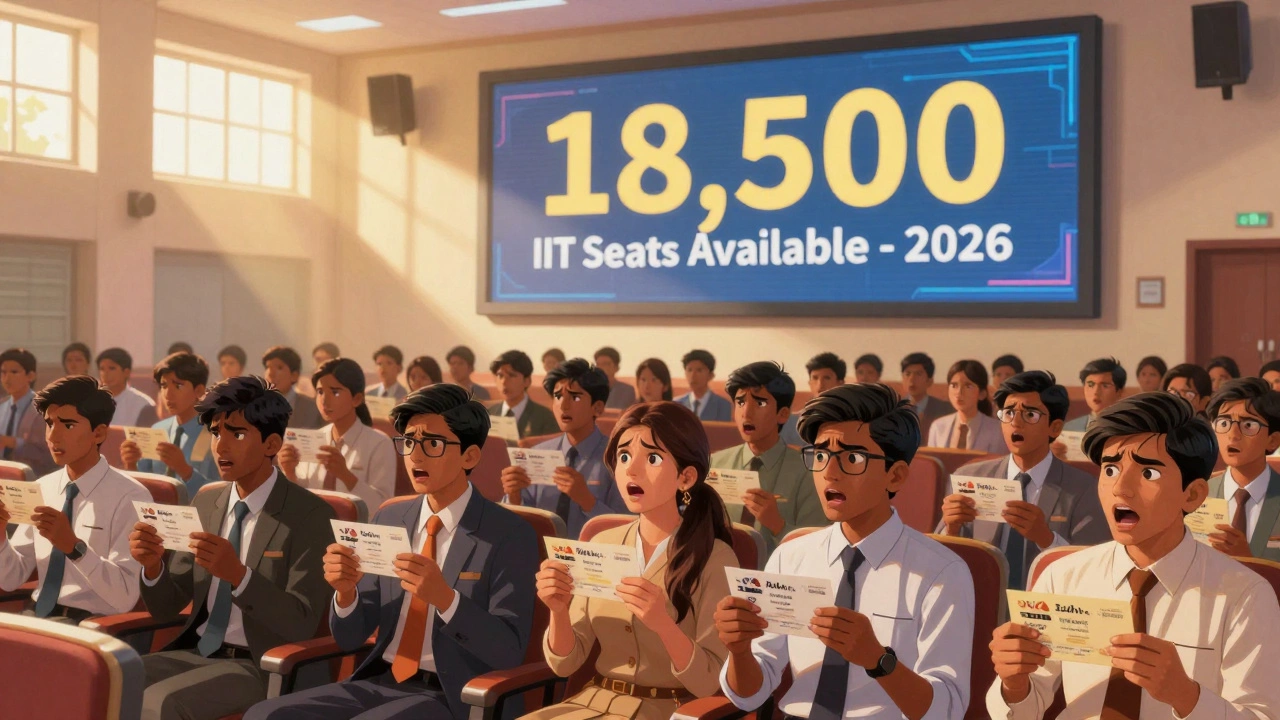
Every year, over 1.5 million students take the JEE Advanced exam hoping to get into one of India’s 23 IITs. But how many seats are actually available? The number isn’t fixed, and it changes slightly each year based on new campuses, government approvals, and infrastructure upgrades. As of 2026, there are 18,500 undergraduate engineering seats across all IITs combined.
Where Do These Seats Come From?
The 18,500 seats aren’t spread evenly. The older IITs like Bombay, Delhi, Madras, Kanpur, and Kharagpur still take the largest share - each has around 1,000 to 1,200 seats. Newer IITs like IIT Bhilai, IIT Dharwad, and IIT Palakkad are still growing. They started with 100-200 seats per year and have now expanded to 400-600 each.
Each IIT offers B.Tech programs in core branches like Computer Science, Mechanical, Electrical, Civil, and Chemical Engineering. Some also have dual-degree programs (B.Tech + M.Tech), integrated M.Sc., and B.S. programs. These count as separate seats. For example, IIT Roorkee offers about 80 dual-degree seats in addition to its regular B.Tech intake.
How Are Seats Distributed?
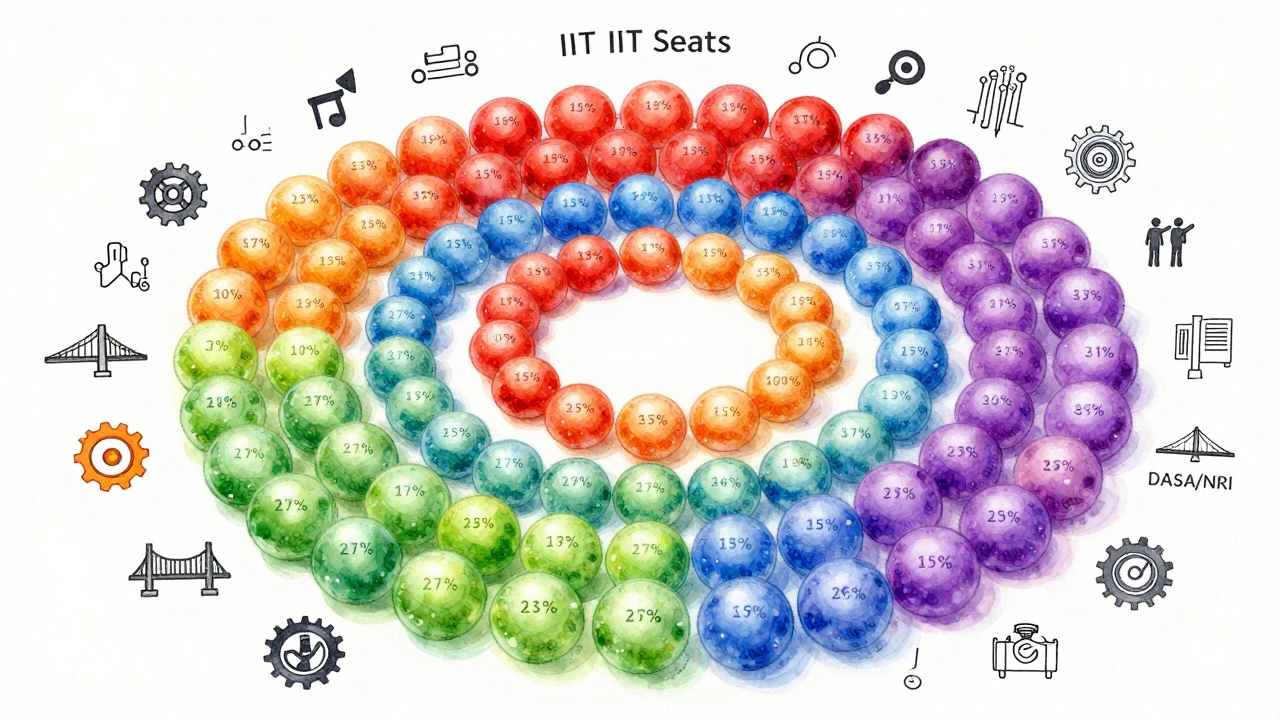
Seat allocation follows strict government guidelines. Around 27% of seats are reserved for OBC-NCL candidates, 15% for SC, and 7.5% for ST. An additional 10% is reserved for EWS (Economically Weaker Sections), introduced in 2019. That leaves about 40.5% of seats open for general category students.
There’s also a 5% horizontal reservation for persons with benchmark disabilities (PwD). This is applied across all categories. So if you’re an SC candidate with a disability, you’re counted in both the SC quota and the PwD quota - not double-counted, but given priority within your category.
Foreign nationals and NRI students get a separate quota - about 10% of total seats are reserved for them under the DASA scheme. These seats are filled through SAT scores and don’t use JEE Advanced ranks.
Why the Number Keeps Changing
In 2020, the total IIT seats were around 16,000. By 2023, they crossed 17,500. The jump to 18,500 in 2026 came after three new IITs - IIT Jammu, IIT Sikkim, and IIT Nagpur - fully operationalized their undergraduate programs. IIT Jammu added 300 seats, IIT Sikkim added 250, and IIT Nagpur expanded from 400 to 600.
The Ministry of Education also approved increased intake in existing campuses. For example, IIT Guwahati added 120 new seats in 2025, and IIT Hyderabad increased its B.Tech intake by 15% after new labs and hostels were completed.
Not all seats are filled every year. Some students get admitted but don’t join - they opt for foreign universities or other top colleges like NITs or IIITs. That’s why IITs sometimes have a small waiting list from JEE Advanced to fill gaps.
What About Branch Preferences?
While total seats are 18,500, not all branches are equally popular. Computer Science and Engineering (CSE) has the highest demand. Around 1,800 CSE seats are available across all IITs. That’s less than 10% of the total seats, but nearly 30% of the top 5,000 JEE Advanced rank holders aim for CSE.
Other high-demand branches include Electrical Engineering (1,400 seats), Mechanical (1,600), and Electronics and Communication (1,200). Branches like Metallurgy, Mining, and Textile Engineering have fewer than 100 seats each - and often go unfilled if students don’t rank high enough to get them.
Many students don’t realize that branch allocation isn’t just about rank. It’s also about choices filled during counseling. If you rank #1,000 but only choose CSE, you might miss out. But if you pick 10 options including less popular branches, your chances of getting into any IIT jump dramatically.
What Happens If You Don’t Get Into an IIT?
Getting into an IIT is hard - only about 1 in 100 JEE Advanced candidates make it. But that doesn’t mean your engineering future is over. NITs have over 25,000 seats. IIITs add another 8,000. And many private universities like BITS Pilani, VIT, and SRM offer excellent programs with global placements.
Some students who don’t get IIT seats still end up in top global universities through SAT or ACT scores. Others join IITs later through lateral entry after completing a diploma or B.Sc. And many who start at NITs transfer to IITs after clearing the JEE Advanced for M.Tech.
The truth? An IIT degree opens doors. But your skills, projects, internships, and attitude open the rest.
How to Use This Info for Your Preparation
If you’re preparing for JEE Advanced, knowing the seat count helps set realistic goals. With 18,500 seats and over 200,000 students qualifying for JEE Advanced, you’re competing for roughly 1 seat per 11 candidates.
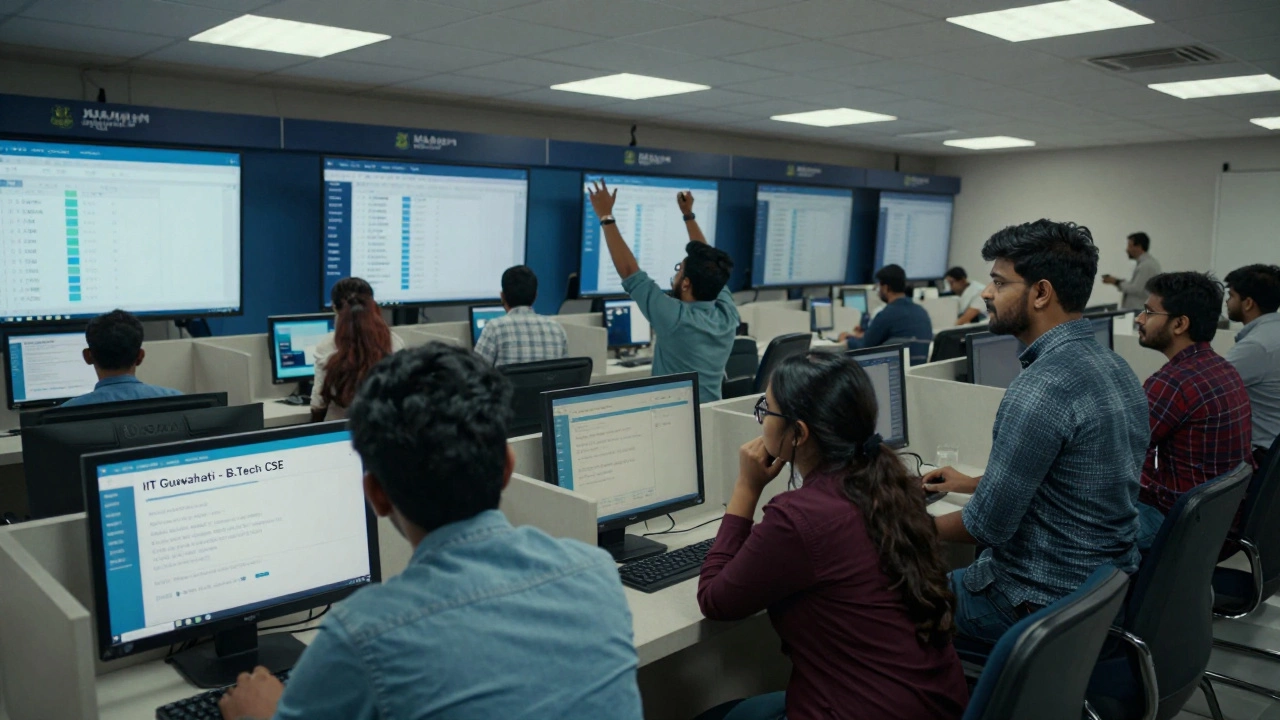
But rank matters more than raw numbers. In 2025, the last seat in CSE at IIT Bombay went to rank #1,050. At IIT Guwahati, the last CSE seat went to rank #2,100. So if you’re aiming for a top IIT and a top branch, you need to be in the top 1,500. For mid-tier IITs and core branches, top 5,000 is enough.
Track the opening and closing ranks from the last three years. The JoSAA portal publishes these after each counseling round. Use them to pick your choices wisely. Don’t just chase CSE. Look at newer branches like Engineering Physics, Mathematics and Computing, or Biosciences and Bioengineering - they’re growing fast and have lower cutoffs.
What’s Next After JEE Advanced?
Once you qualify, you’ll go through JoSAA counseling - the single portal that handles seat allocation for all IITs, NITs, IIITs, and other GFTIs. You’ll fill your branch and institute preferences. Your rank determines your priority.
Don’t wait until the last round. Seats fill up fast. Many students lose out because they keep hoping for a better branch and miss the chance to get into any IIT. If you get an offer in the 3rd round, accept it. You can upgrade later if a better option opens.
Also, remember: IITs don’t have management quotas or donations. Your rank is your only key. No shortcuts. No backdoors. Just hard work, smart preparation, and clear choices.
How many total IIT seats are there in India in 2026?
As of 2026, there are 18,500 undergraduate engineering seats across all 23 IITs in India. This includes B.Tech, dual-degree, and integrated programs. The number has increased from 16,000 in 2020 due to expansion in newer IITs and increased intake in existing ones.
What percentage of IIT seats are reserved for SC/ST/OBC?
The reservation policy for IITs follows the Government of India norms: 15% for SC, 7.5% for ST, and 27% for OBC-NCL. Additionally, 10% is reserved for EWS (Economically Weaker Sections). This leaves about 40.5% of seats for the general category. A 5% horizontal reservation for PwD candidates is applied across all categories.
Are there seats for NRI or foreign students in IITs?
Yes, about 10% of total IIT seats (around 1,850 in 2026) are reserved for foreign nationals, NRIs, and PIOs under the DASA scheme. These students don’t need to take JEE Advanced - they apply using SAT scores, subject test scores, and academic records. Admission is based on merit within this quota.
Which IIT has the most seats?
IIT Kharagpur and IIT Bombay have the largest undergraduate intake, each offering over 1,200 seats. IIT Madras and IIT Delhi follow closely with around 1,100-1,150 seats. Newer IITs like IIT Jammu, IIT Sikkim, and IIT Palakkad are still growing but now each offer 400-600 seats.
Is it harder to get into CSE than other branches at IITs?
Yes, CSE is the most competitive. With only about 1,800 CSE seats across all IITs and over 100,000 students taking JEE Advanced, the cutoff rank for CSE in top IITs is usually below 1,000. In contrast, branches like Civil, Chemical, or Metallurgy can be secured with ranks up to 5,000 or even higher in newer IITs.
What happens if I don’t get a seat in the first round of JoSAA counseling?
You still have multiple rounds - typically 6 to 7 - to get a seat. Seats open up when students withdraw or upgrade to a better option. Many students get into IITs in the 4th or 5th round. Don’t give up early. Keep checking the JoSAA portal and update your choices if needed. Even a lower-ranked IIT or a less popular branch is better than skipping the opportunity entirely.