Fluency Routine & Time Estimator
1. Your Availability
2. Current Level
Estimated time to conversational fluency:
-- Months
Suggested Daily Routine (Based on your time)
| Activity | Goal | Suggested Time |
|---|
Think about the last time you tried to learn a new skill alone. Maybe it was a musical instrument or a coding language. You probably felt a mix of excitement and total confusion. Learning a language is exactly like that, but with one big catch: you can't just read about speaking; you actually have to speak. The short answer is yes, you can become fluent in English by myself, but not if you just stick to textbooks and apps. Fluency isn't about knowing every word in the dictionary; it's about the ability to express your thoughts without your brain freezing up every three seconds.
The truth about solo language learning
Most people think they need a classroom and a teacher to succeed. While a tutor can speed things up, the actual "learning" happens when your brain struggles to communicate a thought. If you spend four years in a classroom but never talk to a real person, you'll be a master of grammar and a disaster at conversation. Self-studying is actually a superpower if you know how to simulate a real-world environment. You aren't just a student; you're your own coach, curator, and conversation partner.
To make this work, you need to move away from the "study" mindset and move toward an "acquisition" mindset. Study is when you memorize a list of irregular verbs. Acquisition is when you watch a sitcom and realize that people don't actually talk like the textbooks say they do. The goal is to surround yourself with the language until your brain stops translating from your native tongue and starts thinking in English.
Building your own immersion bubble
You don't need to buy a plane ticket to London or New York to immerse yourself. You can create a digital bubble right where you are. Start by switching the language settings on your phone and computer to English. It sounds small, but forcing yourself to navigate Operating Systems the software that manages computer hardware and provides common services for computer programs in English forces your brain to associate actions with English words instantly.
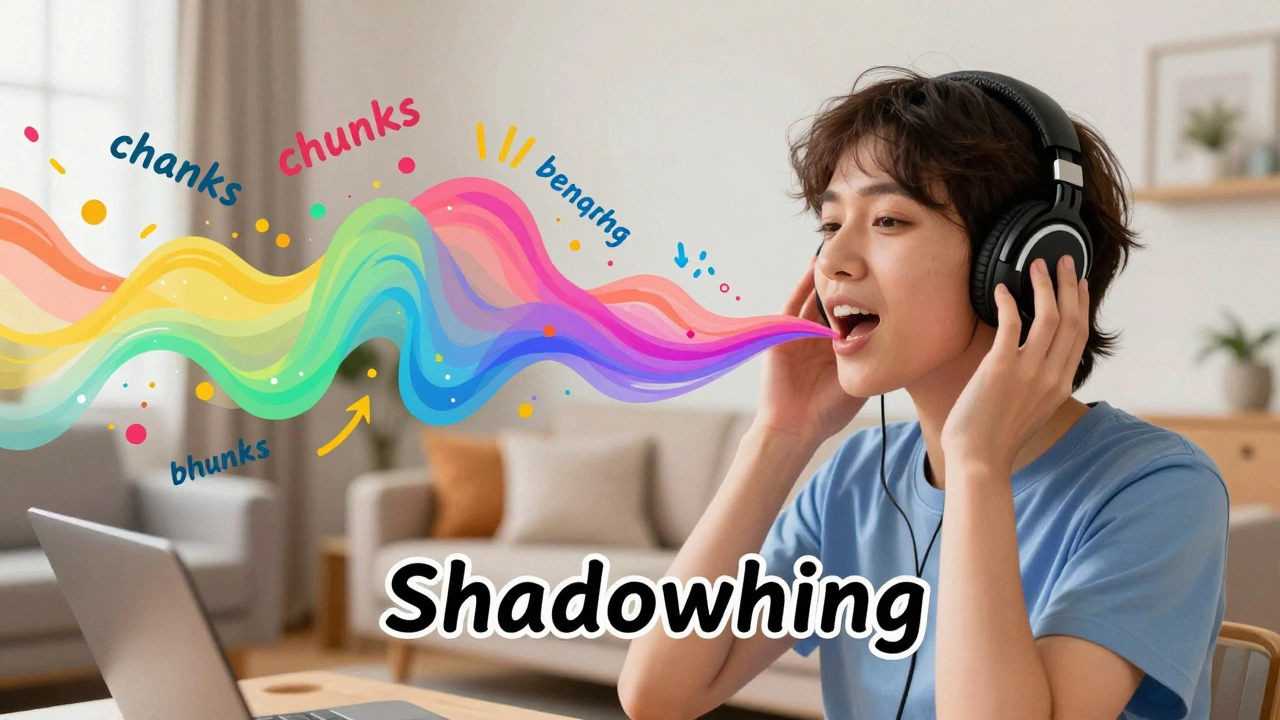
Next, change your media consumption. Instead of watching dubbed movies, switch to original audio with English subtitles. Once you feel comfortable, turn the subtitles off. If you're listening to podcasts, don't just let them be background noise. Try a technique called "shadowing." This is where you listen to a native speaker and repeat what they say almost immediately, mimicking their speed, emotion, and rhythm. It's like singing along to a song, but you're training your mouth muscles to produce sounds that might not exist in your own language.
| Method | Pros | Cons | Best For |
|---|---|---|---|
| Traditional Classroom | Structured path, instant feedback | Slow pace, expensive, formal language | Grammar basics |
| Language Apps | Gamified, convenient, low pressure | Lacks real conversation, repetitive | Vocabulary building |
| Self-Immersion | Free, customizable, real-world usage | Requires high discipline, no correction | Listening and Intuition |
| Language Exchange | Real human interaction, cultural nuance | Hard to find reliable partners | Speaking confidence |
Mastering speaking without a partner
The biggest hurdle for solo learners is the "speaking gap." How do you practice speaking if there's no one to talk to? The secret is talking to yourself. I know it sounds crazy, but narrating your day is one of the fastest ways to find holes in your vocabulary. If you're cooking dinner and realize you don't know the word for "simmer" or "saute," that's a victory. You've identified a specific gap in your knowledge that a generic textbook wouldn't have covered.
Another powerful tool is Voice Recording the process of capturing sound and storing it in a digital format for playback. Record yourself talking about a topic for two minutes. Then, listen to it. You will notice mistakes that you didn't catch while speaking. Maybe you're missing the "s" at the end of third-person verbs, or maybe your intonation sounds flat. By comparing your recording to a native speaker on YouTube or a podcast, you can self-correct your accent and flow.
If you want to level up, use AI tools. Modern LLMs (Large Language Models) can now act as conversation partners. You can tell an AI, "Act as a grumpy landlord and let's argue about the rent," and it will give you a realistic, high-pressure scenario to practice your negotiation skills. It's a safe space to make mistakes before you take those skills into the real world.
The grammar trap and how to avoid it
Many people fail at self-study because they spend 90% of their time on English Grammar the set of structural rules governing the composition of clauses, phrases, and words in the English language. They treat English like a math problem to be solved. But fluency is more like a sport; you don't get better at basketball by reading the rulebook; you get better by playing.
Use the "80/20 Rule" for grammar. Spend 20% of your time learning the rules and 80% using the language. If you're struggling with the present perfect tense, don't just do 50 fill-in-the-blank exercises. Instead, write ten sentences about things you've done in your life. Connect the rule to a personal memory. This creates a stronger neural pathway in your brain, making the grammar a tool rather than a chore.
Focus on "chunks" of language. Instead of learning individual words, learn phrases. For example, don't just learn the word "decision." Learn the chunk "make a decision." Native speakers don't build sentences word by word; they use pre-assembled blocks of language. When you learn in chunks, your speaking speed increases because you're retrieving one large piece of information instead of five small ones.
Overcoming the fear of making mistakes
The biggest wall you'll hit isn't a lack of vocabulary; it's the fear of looking stupid. This is the "Affective Filter," a psychological barrier that shuts down your brain when you're anxious. To break this, you have to redefine what "success" looks like. Success isn't speaking perfectly; success is being understood.
Start with low-stakes environments. Join online forums or communities centered around your hobbies. If you love gaming, join a Discord server for that game. If you like gardening, find a Reddit thread about organic soil. When you're focused on the hobby, the language becomes a tool for a goal, and you stop overthinking every verb tense. The adrenaline of talking about something you love overrides the fear of a misplaced adjective.
Remember that native speakers generally don't care if your grammar is perfect. They care if the conversation flows. If you use the wrong tense but your point is clear, the communication is successful. The more you accept that mistakes are just "data points" for improvement, the faster you'll move toward true fluency.

Creating a sustainable routine
Consistency beats intensity every time. Spending ten hours on a Saturday studying English is far less effective than spending 30 minutes every single day. Your brain needs time to sleep and consolidate the new patterns it's learning. If you cram, you'll forget; if you drip-feed, you'll retain.
Build a "Language Lifestyle" rather than a study schedule. Instead of saying "I will study English from 6 PM to 7 PM," integrate it into what you already do. Listen to an English podcast during your commute. Read one English article during your lunch break. Write your to-do list in English. When the language becomes part of your identity rather than a task on your calendar, the friction disappears.
| Time | Activity | Goal |
|---|---|---|
| Morning | 15 mins English News/Podcast | Ear tuning & Listening |
| Commute/Break | Shadowing 5-10 minutes | Pronunciation & Rhythm |
| Evening | Narrating the day (out loud) | Thinking in English |
| Before Bed | Writing 3-5 sentences in a journal | Active Production |
How long does it take to become fluent by myself?
There is no magic number, but for most people, reaching a conversational level takes about 6 to 12 months of consistent, daily practice. This depends on your starting point and how many hours a day you actually spend using the language. If you spend 2 hours a day in active immersion, you'll see results much faster than someone spending 30 minutes a week on an app.
Do I really need a teacher to correct my mistakes?
A teacher is helpful, but not strictly necessary for fluency. You can use AI tools like Grammarly or ChatGPT to check your writing, and recording your own voice to compare with native speakers for speaking. The key is developing an "ear" for the language so you can eventually notice your own mistakes.
Which is better: watching movies or reading books for fluency?
For speaking fluency, movies and podcasts are superior because they expose you to natural rhythm, slang, and intonation. Books are fantastic for expanding vocabulary and understanding complex grammar, but they don't prepare your mouth and ears for a real-time conversation.
What if I live in a country where no one speaks English?
The internet has erased geographical borders. Use platforms like Tandem or HelloTalk to find language exchange partners. You can also join international gaming communities or professional groups on LinkedIn where English is the primary language. Your "environment" is now whatever you choose to look at on your screen.
How do I stop translating in my head?
Stop using bilingual dictionaries and switch to English-to-English dictionaries. When you look up a word, read the English definition. This forces your brain to stay within the English "loop." Additionally, start labeling objects in your house with English sticky notes so you associate the object directly with the English word, bypassing your native language entirely.
Next steps for your journey
If you're feeling overwhelmed, don't try to do everything at once. Pick one thing from this guide-maybe it's narrating your day or switching your phone language-and do it for one week. Once that feels natural, add another layer. The biggest reason people quit is because they try to sprint a marathon. Treat your language journey like a lifestyle change, not a school project.
If you hit a plateau where you feel you've stopped improving, it's usually because you're staying in your comfort zone. Start consuming content that is slightly too hard for you. Read a technical paper, watch a debate, or try to explain a complex philosophical concept out loud. That slight struggle is exactly where the growth happens.