
Success Path Calculator
Your Success Path Assessment
Based on the article "Are Humans Naturally Competitive? The Truth Behind Competitive Exams," this tool helps you identify alternative success paths beyond traditional competitive exams.
Your potential success paths outside traditional exams
Why do millions of students in India wake up at 5 a.m. to study for JEE, NEET, or UPSC? Why do parents spend their life savings on coaching centers? Why do students cry after missing a cutoff by one mark? It’s not just about getting a job or a seat. It’s deeper. It’s about a belief that we are wired to compete - that competition isn’t imposed by society, but built into us.
Competition Isn’t Just a System - It’s a Survival Instinct
Look at any animal in the wild. Lions fight for territory. Birds sing louder to claim mates. Even ants compete for food paths. Humans aren’t exceptions. We evolved in environments where resources were scarce. The strongest, fastest, most strategic survived. That’s not a theory - it’s biology. The same drive that made our ancestors outlast rivals in the savannah now pushes a 17-year-old in Kota to solve 50 math problems before breakfast.
Neuroscience backs this up. When you win a competition - even a small one like topping a mock test - your brain releases dopamine. That’s the same chemical activated by food, sex, or drugs. Your body doesn’t distinguish between winning a race and beating 800,000 others in JEE. The reward feels real. That’s why competition feels addictive. It’s not just about grades. It’s about feeling alive.
But Is Competition Natural - or Just Normalized?
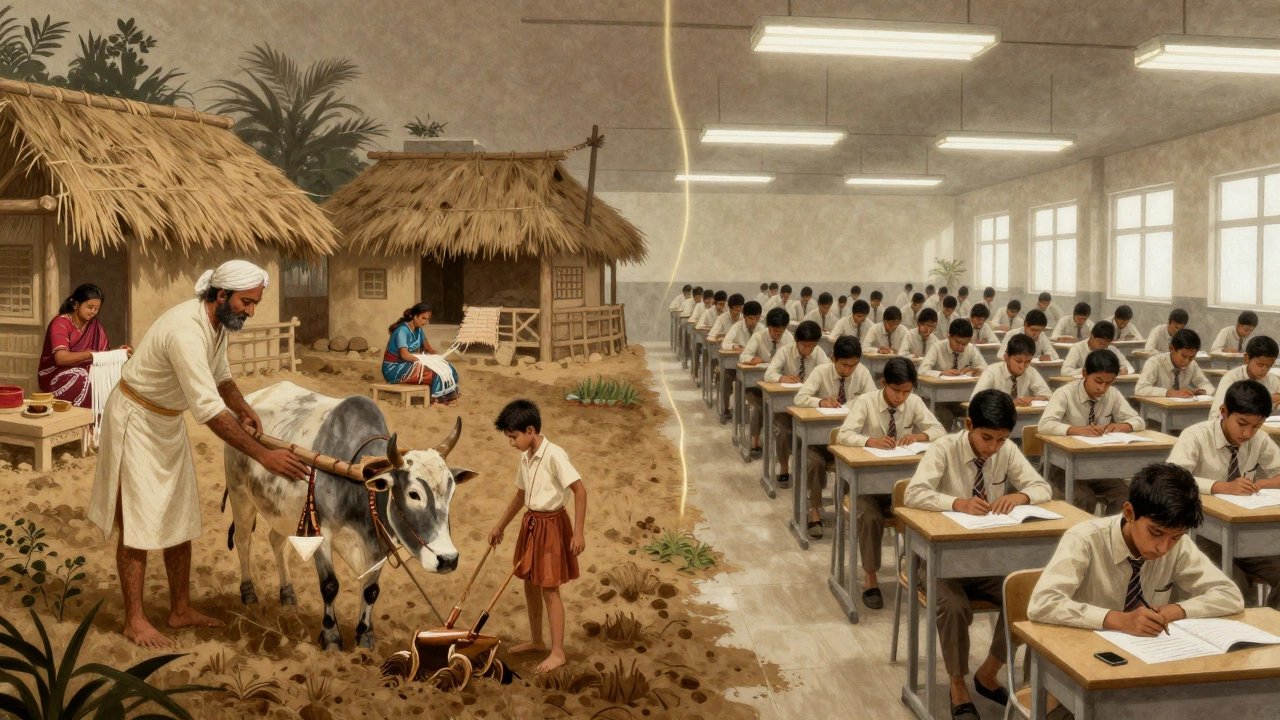
Here’s the twist: while the urge to compete is natural, the scale and structure of modern competitive exams aren’t. No human ancestor ever had to memorize 1,200 physics formulas to get into a university. No tribe ever ranked its children by percentile scores. The pressure we feel today isn’t biology - it’s a system we built.
Think about it. In rural India 50 years ago, a child’s future wasn’t decided by a single exam. Skills were passed down. A boy learned farming from his father. A girl learned weaving from her mother. Success wasn’t measured in ranks. It was measured in survival - and community contribution. Today, success is defined by a 3-hour test. That’s a cultural shift, not a biological one.
Studies from the University of Cambridge show that children raised in cooperative environments - where teamwork is rewarded over individual ranking - develop less anxiety and higher creativity. But in India, we’ve turned education into a zero-sum game. One student’s admission means another’s rejection. That’s not nature. That’s policy.
Why Do We Keep Playing the Game If It’s So Stressful?
If competition is so draining, why don’t we quit? Because we’ve tied survival to performance. In a country where 70% of jobs require a degree, and where only 3% of engineering seats are in top institutes, the exam becomes a gatekeeper. Not because it’s the best way to measure talent - but because it’s the only system we’ve agreed on.
Parents push because they remember what it was like to struggle. They didn’t have coaching. They didn’t have internet. They studied under a single bulb. So when their child gets a coaching center with AC and mock tests, they see it as opportunity - not pressure. They don’t want their child to suffer like they did. They want them to win.
Students keep going because they believe the system works. And sometimes, it does. A boy from a village in Bihar cracks NEET. He gets a seat in AIIMS. He becomes a doctor. His family’s life changes. That story is real. That’s why the myth persists: if you work hard enough, you’ll win. The truth? Hard work matters - but so does luck, access, coaching, and socioeconomic privilege.
The Hidden Cost: Mental Health and Lost Potential
Every year, over 300 students in India die by suicide linked to exam failure. That’s not a statistic. That’s 300 families shattered. Behind each number is a child who believed their worth was tied to a rank. A child who thought if they didn’t get into IIT, they were worthless.
What happens to the 97% who don’t make it? They’re told to try again. Or to take a drop. Or to settle for a private college. But no one asks: what if they’re brilliant at something else? What if they’re a painter, a musician, a coder, a carpenter? The system doesn’t see them. It only sees scores.
There’s a reason why countries like Finland don’t have competitive exams until age 16. They focus on learning, not ranking. Their students consistently rank among the top in global education surveys. Not because they’re smarter - because they’re less afraid.
Competition Isn’t the Enemy - Misplaced Values Are
Competition isn’t bad. It pushes us to improve. But when we reduce a human being to a rank, we lose sight of what matters. A student who scores 99% in JEE but can’t solve a real-life problem? That’s not success. A student who scores 60% but runs a successful YouTube channel teaching physics to rural kids? That’s impact.
Real talent isn’t measured in marks. It’s measured in curiosity, resilience, and the ability to keep learning. The best engineers I’ve met didn’t come from IIT. They came from small towns, failed exams, and kept building things anyway. One of them now designs low-cost water filters for villages. He never cracked JEE. But he solved a real problem.
Our obsession with competition isn’t natural. It’s learned. And if it’s learned, it can be unlearned.

What Can We Do Instead?
Change starts with redefining success.
- Stop asking, “Which college did you get into?” Ask, “What are you building?”
- Stop glorifying 100th rank. Celebrate the 1,000th who kept trying.
- Encourage projects over memorization. Let kids build apps, start blogs, fix broken machines.
- Support alternative paths: vocational training, apprenticeships, entrepreneurship.
- Teach emotional resilience like you teach math.
There are already signs of change. States like Kerala are reducing syllabus pressure. Some private schools are dropping ranking systems. Startups are hiring based on portfolios, not degrees. The system is cracking - not because it’s broken, but because people are waking up.
Final Thought: You Are Not Your Rank
Human beings are not designed to be ranked. We’re designed to create, connect, and care. Competition can be a tool - but only if we control it. Not the other way around.
If you’re sitting for an exam right now, know this: your worth isn’t in the answer sheet. It’s in the questions you ask. The risks you take. The help you give. The way you get up after falling. That’s what lasts. Not a rank. Not a college name. Just you - real, messy, and unstoppable.
Are humans naturally competitive or is competition learned?
Humans have a biological drive to compete - it helped our ancestors survive in resource-scarce environments. But the extreme, high-stakes competition we see in modern exams like JEE or NEET is not natural. It’s a social construct. Our brains respond to winning with dopamine, but the scale, pressure, and ranking systems are created by society, not evolution.
Why do competitive exams cause so much stress in India?
In India, access to quality education, jobs, and social mobility is heavily tied to performance in a few high-stakes exams. With limited seats in top institutions and a cultural belief that success equals a top rank, students face immense pressure. Parents, schools, and media reinforce this, making failure feel like personal collapse - not just a setback.
Do competitive exams measure true ability?
Not really. These exams test memory, speed, and test-taking strategy under pressure. They don’t measure creativity, emotional intelligence, problem-solving in real life, or long-term persistence. Many brilliant people - inventors, artists, entrepreneurs - failed these exams. Their success came from curiosity and grit, not marks.
Is it possible to succeed without cracking competitive exams?
Absolutely. Thousands of people in India are building successful careers through vocational training, online skills, freelancing, and entrepreneurship. Companies like Flipkart and Zomato hire based on portfolios and projects. Government schemes now support skill-based jobs. Success is no longer tied to one exam - but society hasn’t caught up yet.
What are some alternatives to competitive exams?
Alternatives include project-based assessments, skill certifications (like NCVT or NSQF), apprenticeships, entrance through portfolios (used in some design schools), and direct admission based on extracurricular achievements. Countries like Finland and Germany use holistic evaluations. India is slowly experimenting with these - especially in private colleges and vocational education.
How can parents reduce exam pressure on their children?
Parents can shift focus from ranks to learning. Ask: “What did you enjoy today?” instead of “What rank did you get?” Encourage hobbies, allow failure, and share stories of people who succeeded after failing exams. Avoid comparing siblings. Celebrate effort, not just outcomes. A child who feels safe to fail will learn more than one terrified of falling behind.